Want to join in? Respond to our weekly writing prompts, open to everyone.
A little web of thoughts about culture and language
from kallecederblad
The urge to write and think about language and culture seems to stick with me for the forseeable future. Giving another project I’ve been pondering for a while a try: Kultur och kontext. That will be in Swedish and a space for reflecting about society, culture, literature and art without the didactic undertones that come with my other Svenska med Kalle-projects. Check it out if you want to read in Swedish or are curious enough to pull it through a translator.
I don’t know if I exaggerate the rich societal and cultural contextual aspects of communicating. A lot of language training to me seem to understate it. As if a substantial vocabulary and good enough syntactics would be enough to get through social life with a new language in a new culture. That seems to underestimate the challenge of the learner. And anyhow I think there is a lot of people learning a language that want to be able to talk about more advanced topics like societal issues or their favourite cultural areas. There should be some interest in writing covering those areas of language, interpreted broadly, and in my case with a focus on Sweden and Swedish. We’ll see if there is an audience, however small, for these topics and perspectives. The good thing for the writer is that every text is just another opportunity to sharpen the pen and develop the ideas. The audience is the icing of the cake or something like that.
Take a look if you like and feel free to respond if you have feedback, questions or just want to cothink around something.
/Kalle
Från språket till kulturen, Svenska med Kalle men ett annat fokus
from kulturochkontext
På min Substack Svenska med Kalle har jag länge skrivit om samhälle, kultur, litteratur och konst på olika sätt. Jag tycker det är lika viktiga dimensioner av att använda och behärska ett språk som ordkunskap och grammatik. Språket befinner sig alltid i en rik kontext. Dock finns det alltid på Substacken och på min i vinteride slumrande YouTube-kanal ett explicit eller implicit språkperspektiv. Jag skriver och talar anpassat. Jag ser så gott som alltid till att texterna ska ge några möjligheter att plocka upp ord, fraser och uttryck. Det finns ett instrumentellt mål att texterna ska hjälpa läsaren att utöka sitt ordförråd i teknisk mening, även om texterna är berättande och/eller reflekterande.
Det har dock länge hos mig grott en längtan att få lämna det instrumentella bakom mig och bara skriva och tänka om den rika mänskliga kontext som omger människans språkande utan att samtidigt undervisa i aldrig så subtil bemärkelse. För mig har arbetsnamnet för detta vara kultur och kontext, kanske mest för att det är snyggt med allitterationer.
Man måste pröva en idé för att så på vad och hur långt den bär. Så här börjar experimentet. Om projektet tar fart blir det ett komplement till det gängse skrivandet på Svenska med Kalle. Jag har fortfarande för mycket lärare i mig för att inte vilja skriva texter där jag kan smuggla in pedagogiska kulturtips och samtidigt lära ut en fras eller ett ord.
Men här tänker jag mestadels strunta i både anpassningar och strategiskt insmugglande av “nyttigt” språk. Jag älskar skrivande som kommunikation och reflektion och här tänkte jag bara köra på. Den som lär sig svenska och gillar mina texter kan också se det som nästa svårighetsgrad. Troligtvis kommer språket här bli både mer idiomatiskt och syntaktiskt avancerat.
Så får vi se om någon vill läsa också. Den hugade ska kunna kommentera eller svara på texter om jag har fått till inställningarna här på Write.As. Det ska även gå att följa bloggen på Mastodon @kulturochkontext@write.as.
Du som läser får gärna hjälpa till att sprida bloggen till andra som kan vara intresserade. Jag kommer ta det hyfsat lugnt med att promota idén tills jag vet om jag själv tycker det är tillräckligt intressant för att hålla igång det över tid. Några läsare som vill haka på tidigt vore förstås kul för att se vad som väcker tankar och engagemang.
Det kan nog räcka som presentation så länge. Vem vet vad framtiden bär i sitt sköte. Den som lever får se!
Allt gott tills nästa gång!
/Kalle
from  Talk to Fa
what if i didn’t have to leave this? what if this was my home?
Friday
from  Roscoe's Story
In Summary: * I've just taken the first round of my night meds and I'm listening to the first series of downs in this college football game between the UCF Knights and the Iowa St. Cyclones. I'll take my final round of night meds and finish my night prayers after this game ends. Sleep will probably send me to bed shortly after that.
Prayers, etc.: * I have a daily prayer regimen I try to follow throughout the day from early morning, as soon as I roll out of bed, until head hits pillow at night.
Health Metrics: * bw= 222.10 lbs. * bp= 134/60 (60)
Exercise: * morning stretches, balance exercises, kegel pelvic floor exercises, half squats, calf raises, toe raises, wall push-ups, BP breathing exercises, pilates
Diet: * 05:35 – 1 banana * 06:20 – 1 pb&j sandwich * 07:40 – little chocolate chip cookies * 10:00 – pizza * 13:00 – snack on cheese * 14:20 – seafood salad * 15:20 – little chocolate chip cookies * 16:00 – 1 fresh apple
Activities, Chores, etc.: * 03:00 – listen to local news talk radio * 04:05 – bank accounts activity monitored * 05:00 – read, write, pray, follow news reports from various sources, surf the socials, take daily meds, unpack, organize, and nap * 11:00 – listening to Minnesota Golden Gophers Sports Network bringing pregame broadcasting ahead of today's men's college basketball game as Minnesota plays the Oklahoma State Cowboys in the first game of the 2026 Charleston Classic * 14:00 – listening to my 2nd college basketball game of the day from the Virginia Tech Sports Network, Virginia Tech Hokies at Northwestern Wildcats * 14:20 – eat lunch at home with Sylvia * 14:40 – back to basketball * 16:20 – listening to the Cyclones Sports Network Pregame Broadcast ahead of tonight's college football game between the UCF Knights and the Iowa State Cyclones
Chess: * 16:58 – moved in all pending CC games
Working Note: George Orwell & The Pivot of 1945
 The Essayist's Notebook
Core Thesis
The Orwell who wrote Animal Farm (1945) and Nineteen Eighty-Four (1949) is fundamentally different from the young writer who observed a condemned man stepping aside to avoid a puddle in “A Hanging” (1931). Between those two points, Orwell’s political disappointment hardened into a solitary cynicism that he seems to have resulted in declaring his opinions as universal truths. Because he experienced disillusionment largely alone, rather than from within an active, enduring collective, he found it easier to deny that mass movements could ever build anything lasting, than to remain engaged in the messy work of building them. Ultimately, his cynicism was a refusal to endure the open wound of collective struggle.
The Textual Snapshot: “Good Bad Books” (November 2, 1945)
• The Context:
Published in Tribune just months after Animal Farm (August 1945), the essay grew out of an unpublished introduction Orwell wrote for a planned cheap reprint series (specifically for Leonard Merrick’s The Position of Peggy Harper).
• The Reveal:
Often read as a charming, populist defense of light reading, “Good Bad Books” actually exposes Orwell’s underlying literary snobbery and elitism. Borrowing G.K. Chesterton’s phrase, Orwell insists that popular, readable books lack true “literary merit”; requiring the sophisticated critic to consciously lower his standards to enjoy them.
• The Parallel (Hook: Raymond Williams & Structures of Feeling):
Just as Orwell no longer trusted the masses to build a just society without succumbing to tyranny or herd mentality, he no longer believed popular culture possessed genuine artistic dignity.
Contrast this with Raymond Williams’s concept of “structures of feeling” (and Culture and Society): where Williams saw lived, collective experience and popular forms as active, legitimate sites where shared meaning and new social consciousness are forged, Orwell treats popular reading merely as passive, second-rate escapism. Having stepped outside collective struggle, Orwell can no longer recognize the ordinary as a creative force; setting himself apart instead as the discerning gatekeeper standing above the uncritical crowd.
Key Thread & Metaphor: “Two Legs Better”
• From Solidarity to Elevation:
In “A Hanging,” the puddle moment erases all distance between observer and subject through shared human vulnerability. By 1945, that horizontal solidarity has been replaced by vertical hierarchy.
• The Unintended Self-Indictment:
In Animal Farm, the pigs’ revision of the farm’s founding egalitarian maxim, “Four legs good, two legs better”, satirizes elites who use sophistication to justify standing above the herd. Read against “Good Bad Books” and his late cynicism, the line doubles as an accidental confession of Orwell’s own posture: the lone, clear-eyed intellectual walking upright while looking down on both mass culture and collective political hope.
Key Texts & Anchors to Pull From Later
- “A Hanging” (1931) – the puddle passage (embodied, egalitarian empathy).
- Animal Farm (August 1945) – the final scene / “Four legs good, two legs better” (the elevation of the detached elite; ).
- “Acting For, Acting With” – essay, David Marshall
We’ve fixed a bug in RSS feeds where post summaries could start with garbled text, and include leftover bits of HTML. Now feed readers show a clean, plain-text summary of each post, and still include the full post as always. This fix covers blog feeds, plus feeds on Read Write.as, Submit.as, and Snap.as.
This was previously reported in WriteFreely issue #1778.
#updates #RSS #fixes #writeas
49° And Raining, Yummy Goulash & Dolly In The Holly
from  Hello From Juliet
 Hi Blog friends!
Hope this week’s post is finding you well in spite of what the news says is happening to many in our world right now.
Woke up to a cool and cloudy 49° F here in our part of Southern California this morning, and it was unusually cloudy and raining here all day yesterday. I found it refreshing after so many consecutive days of sunshine – so I enjoyed it. Paul and I finished watching The Marvelous Mrs. Maisel earlier this week, and a string of extremely sloppy lackluster updates caused me to stop using my beloved Rosebud self care companion AI journaling app. But, on the upside - I found and started listening to a sound frequency on YouTube that’s helping ease my menopausal aches, pains and discomforts. My body and I aren’t totally out of the woods, but we’re feeling much better than we were! I also made a few modifications to the Mac n cheese recipe for our rice cooker and made a really awesome tasting goulash last weekend, learned about the original Jay Day Dress Company and stumbled upon the Dolly On The Holly plushie on Amazon. It’s super cute – Dolly Parton comes dressed in a Santa coat, and there are shoes, a guitar, a mic and a mic stand. If you’re buying or bought one, let us know in the Facebook comments on this post here. Or you can email us too.
No new creative work to share this week. Cute Snail coloring pages, coloring postcards and coloring books are still available for 100% FREE download however.
This week’s coloring page is Cute Snail SNAIL-TASTIC Thanksgiving. A matching cut and fold coloring postcard is available as well. Digital sharing postcards are also available in the download if you’d like those.
Hope to write again next week. Until then…. 👋
❤️ Juliet
IMAGE ID: A close up picture of the goulash I made in our rice cooker last weekend.
————-
About Me | Email | Download (And Shop Cute Snail) – Scroll down to the bottom of this page if you’d like to subscribe to this blog.
from Jours de J.

il se moque des nuages sagement alignés avec la mer et la jetée, — l'oiseau en vol libre !
photo c @Adamo@pixelfed.uno
Are We Designing Better Lessons or AI-Proof Assignments?
from Laura Bungarz
As teachers, we understand what makes a good lesson.
It’s engaging for students so they want to learn about it and do the work associated with it.
It is something the students can understand. It’s not too hard or too easy.
It is valuable to the students giving them a reason to be engaged.
The instructions are clear so students aren’t confused about what to do.
We should be considering these things every day. But maybe our own motivation for doing these things has changed. Maybe it’s no longer about creating a good, engaging lesson, maybe now it’s more about preventing students from using AI to do their work.
I get that teachers are overwhelmed and overworked. Sometimes you just need a quick lesson. Sometimes you don’t have the time or the bandwidth to make the lesson as exciting as you might have. From that perspective, it’s a system problem. Classes are too full and teachers don’t have enough help to manage them well.
To put it bluntly, the crap rolls downhill. If the teacher is overwhelmed and is taking short cuts in their planning because classroom survival requires that, and we have a world where students can have AI do their homework for them, something is going to give. This isn’t a new problem. Students will find ways not to do their homework. AI just simplifies the problem of figuring out how to hand something in without doing much. Students have always been on the losing end of teachers trading off engagement for survival, long before AI. But AI makes the trade increasingly more of a gamble than simply the consequence of a system that overwhelms its teachers.
Teachers have to address the motivation issues, the instructional design problems, the somewhat under-planned, less than ideal lesson because they ran out of time, and also wrestle with the idea that if they don’t do all of that and students mentally check out, they are more likely to get an AI completed assignment.
Many of the solutions that I’ve offered in the past have intentionally changed the structure of teaching to move assignments back into the classroom to be done by hand on paper. Why? Because it doesn’t add any additional work. It doesn’t make the teacher try to do more in the same amount of time. It allows the teacher to control the environment, so that even if the lesson is not ideal, the student doesn’t get access to AI so they have no choice but to figure it out or not do it.
Let’s be honest, that’s not ideal either. The ideal solution is to have enough time and resources to give every student the attention and support they need. Even that doesn’t completely solve the problem, because even with all of that present, some students will still choose not to do the work.
We were never able to completely prevent cheating. All the rules in the world did not prevent some students from trying to cheat. I believe AI misuse will fall into that same pattern. It will never be a fully solvable problem. But can we do better than we are now?
If our only motivation for building better lessons is to prevent AI misuse, I think AI exposed something we didn’t want to admit: Teaching those better lessons is a lot of work and a lot of time that most teachers simply don’t have. That’s not an individual problem. That’s a system problem that we’ve been paying lip service to for a long time.
Yes, there have been plenty of laws limiting or creating targeted class sizes. Here in Manitoba, the target is 20 kids in Kindergarten to Grade 3 classrooms and 25 kids in grades 4 to 8, with no defined limits in high school.
While the school divisions are doing relatively well after having looked at their class size trackers*, the number of kids in the room is not the only determining factor for a teacher. How many needs are there in that same room? You can have only 5 students in a room, if just one of those students is bouncing off the walls, that room can be difficult to manage alone. We’re not talking about classrooms of 5 students either, we’re talking about 18, 20, or more students in a room, with potentially multiple students bouncing off the walls making it increasingly difficult to manage the classroom alone.
Are teachers the ones responsible for solving the AI cop-out problem through better planning?
No, of course not because in the current structure there is no way to consistently give them enough time to plan and give every student the needed level of individual attention they require. To fix the system purely from a ratio driven standpoint of teachers to students, the ratio would have to be considerably lower than 1:20. Even a ratio of 1:5 can be challenging depending on who is in the room, which makes fixing ratios alone an incomplete answer.
But I think there is a better question. Are we suddenly more concerned about the quality of lessons because students aren't learning, or because AI has made it harder to determine whether they're learning or not?
AI misuse brought lesson planning back into the discussion. That discussion seems to be coming from a couple of different directions. The first is driven by the question of whether to get technology out of classrooms or not. The second is driven largely by planning better in an attempt to gain more buy-in from the students themselves.
The first option of simply removing technology from the classroom and going back to a more old-school approach to teaching seems like the simplest option. It would be easy for many teachers to revert back to physical textbooks, pencils, and paper. Students hand write everything. They go to the library and research in physical books instead of online. The only technology in the school is a calculator. But did that environment do a good job of teaching students to think? Did that create an ideal world of intelligent thinkers? Would that actually fix the problem?
The second option requires teachers to solve a problem they didn’t fully create. The problem is largely systemic. So what’s the answer?
I believe we need to stop treating technology, education, thinking, and employment as competing goals. They all affect each other. It’s hard to do one without needing or affecting one or more of the other ones.
- If I remove technology from school, I affect their ability to gain employment later and I disconnect the school environment from the larger world.
- If I remove job preparation from being one of the purposes of school, then I create a disconnect between the school system and the future life of the students, which includes employment and technology.
- If I don’t teach students how to think, it will be difficult for them to assess AI output, online articles, and any other sources of information, including physical books.
- If I don’t educate students by giving them the foundational skills they need to live their lives, then I affect their ability to participate in society as a functional human being, with or without a job and technology.
If they aren’t competing priorities and they all affect each other, then how do we balance them?
I think that’s the question that remains unanswered. A lot of the discussion moves in the extremes of needing to remove one to focus on another. I don’t believe that’s the right approach.
Teaching students to think and preparing them for the larger world means teaching technology and that technology is increasingly including generative AI.
How do we manage generative AI and still assess learning?
- By directly teaching AI use in the classroom.
- By assessing AI output in the classroom.
- By comparing an AI written essay to a student’s essay and critically thinking about both.
- By using physical books when it makes sense.
- By using pencils and paper when it makes sense.
- By understanding the foundational goal of the lesson and then designing lessons around that instead of designing lessons solely around learning the content.
If I’m teaching ecosystems as a means of teaching the foundational skill of scientific inquiry, then I can’t simply test how much a student learned about ecosystems because that doesn’t tell me whether or not they understand scientific inquiry. AI will generate an ecosystem essay. It can tell me everything I ever wanted to know about ecosystems for a grade 7 assignment. That’s the thing we’re trying to avoid.
As the teacher, how do I assess the student's ability to conduct scientific inquiry rather than simply assess the product of that inquiry? This brings us back to a very simple question that teachers ask every time they plan anything. What method best teaches or assesses a given skill?
Sometimes the answer is pencil and paper. If we’re assessing scientific inquiry through ecosystems in a grade 7 classroom, then maybe having the students do the assessment with a pencil and paper is the best way to assess that learning. But if the path to that assessment is entirely driven by the content knowledge of the ecosystem and the student generates all of that work with AI, then we can’t be surprised when they can’t do an assessment that asks them for the scientific inquiry the assignments never actually required.
The foundational skill we’re trying to teach determines the method. Not all skills are best taught on paper anymore because technology and AI are needed sometimes. But not all skills are served by technology and AI either. Printing is a skill that kids need to learn with pencils and paper. We learn to multiply without a calculator. But then by high school, there are places where a calculator serves the objective better. AI and technology are no different.
But unlike the calculator, I don’t believe that students are best served by creating Kindergarten to grade 8 classrooms that are entirely technology free. I do believe in balance, but I also believe in the slow integration and increasing use of technology as we progress through the grades.
Technology, to me, as we move into the later grades, is like pen and paper. It is a tool, not a subject, and therefore it should be used as a tool. In Kindergarten to grade 3 classrooms, it is more of a separate intentional subject because most of the skills being taught are so foundational, those objectives are not necessarily best served on the computer. As we move into grades 4 to 6, technology is slowly becoming less of a separate subject and more of an intentional daily tool. By grade 8, technology is simply another tool for teachers to use.
All of this requires one thing: teacher training. Systemic issues such as the ones I’ve addressed, are not resolved by individual teachers alone. They are resolved by the system intentionally training its teachers to integrate technology and use AI well. That takes training and practice. It takes time.
The immediate fix is not to ban AI or remove technology from the classroom, it is to begin the process of learning how to teach in a technology rich, AI driven world. The foundational skill of teaching has not changed. What has changed is the introduction of a new method, which is technology based learning. That means deliberately designing instruction around the capabilities technology provides, not just simply using technology to perform familiar classroom tasks. Technology has changed what knowledge is important, what skills are needed, and how we teach all of it.
Until we get beyond the argument of all or none, I don’t think we’ll ever fully address the underlying issue or answer the question. It’s not a question of whether we teach technology or not. It’s a question of how and when we teach it. We answer that question by first understanding what we’re actually trying to teach and then figure out what method best serves that outcome. The question doesn’t have a black and white answer. There are many ways to teach an individual skill.
We need to stop debating whether teaching and learning have changed and instead start figuring out what we need to do differently. It starts with teacher training and support, access to technology, and a willingness to learn a new way of doing things.
*Class Size Trackers
Pembina Trails School Division
River East Transcona School Division
St. James-Assiniboia School Division
*Originally posted on Substack.
The MAG weekly Fashion and Lifestyle Blog for the modern African girl by Lydia, every Friday at 1700 hrs. Nr 235 20th November, 2026
from  M.A.G. blog, signed by Lydia
Lydia's Weekly Lifestyle blog is for today's African girl, so no subject is taboo. My purpose is to share things that may interest today's African girl.
This week's contributors: Lydia, Pépé Pépinière, Titi. This week's subjects: The Power of Repeating Outfits—And Looking Better Every Time, Cancer, and Party Galore
The Power of Repeating Outfits—And Looking Better Every Time. Let’s settle this once and for all ladies: repeating outfits is not a crime. Yes, Susan from accounting may have seen you in that blazer last Tuesday. And guess what? She survived. You can wear it again.
Stylish women repeat clothes all the time because having great style doesn’t mean buying a new outfit for every meeting, wedding, brunch and random “let’s take pictures” moment.
It means knowing how to remix what you already have like the fashionable genius you are.
Wear that same dress again—but add a belt. Change the heels to sneakers. Throw on a blazer. Carry a different bag. Suddenly, the outfit has returned with a new personality and a better attitude.
 For the Accra corporate girl, repeating outfits is basically a survival skill. Between the traffic, the heat and the daily struggle of figuring out what to wear to work, your wardrobe favourites deserve overtime pay!
The trick is simple: repeat the clothes, not the exact styling;
Change the shoes.
Switch the bag.
Add some dramatic jewelry.
Layer differently.
 Change your hairstyle and suddenly—new woman, who dis?
And honestly, if an outfit looked good the first time, why should it disappear into wardrobe retirement?
Wear it again. Wear it better. Wear it with confidence.
Because the goal isn’t for people to say, “She has never repeated an outfit.”
The goal is for them to say, “Wait… is that the same outfit? Why does she look even better this time?!”
Cancer. The world’s population is growing at less than 1 %, but cancer cases are growing at 3%. Most known cancers are breast and lung cancer, next is prostate cancer and then a whole lists of others. More and more treatments are available and if the cancer is detected very early there is a reasonable success chance, but only available if you have the money. Why cancers? The bigger part is attributed to poor quality air and chemicals in our food and environment, for example in plastics we use, or paint in our rooms. But there is an often overlooked factor. Our body has millions of ways of defending itself, it is called the immune system. During Covid we had relatively few casualties because for most of us our immune system is very alert, we regularly have running stomachs, typhoid infections, malaria, what not. and we just grin and bear it. In the west, where they take a pill against anything they (think) they feel their immune systems have half fallen asleep and Covid casualties were much higher.
 How to boost our immune system and reduce the chances of getting cancer? Simple and cheap. Sleep 7–9 hours a night. Eat for your gut, as about 70% of our immune system is associated with the gut.
Eat daily: Fruits: oranges, pawpaw, mangoes and bananas, which provide vitamin C and many other nutrients. Vegetables: kontommire, spinach, carrots, pepper, tomatoes, okra and garden eggs. Protein: fish, eggs, chicken, beans and groundnuts. Your body needs protein to make antibodies.
Fermented foods: Nunu, kenkey, banku and koko (except yoghurt).
Healthy fats: groundnuts, avocado and olive oil. Try to stay away from palm oil (Frytol).
Garlic, ginger, onion and dawadawa in your soup also help a lot.
Avoid too much sugar, Coca-Cola, Malta, fried foods and alcohol.
Drink water: 2–3 litres a day.
Move your body: 30 minutes of walking, dancing, farm work or football, five days a week.
Sun + Vitamin D: 15–20 minutes of morning sunshine, before it gets too hot. Vitamin D is important for immunity. Fish and eggs also help.
Stress: Reduce it. Rest, talk to friends, laugh and practice deep breathing for five minutes a day. Don't stay up worrying every night. What about supplements? Waste of money, and most sell faaaar too expensive, good food first. Good food is expensive? Not really, is a visit to the clinic cheap?
Party Galore. This time of the year always has plenty to offer, from fashion shows to musical concerts, I can’t mention all here but will give a few.
RodR (Rhythms on Da Runway, scheduled for 28th November 2026 at the Grand Arena Accra International Conference Centre). Tickets cost 500 GHC. This year's theme is UNBOUND, celebrating fashion, music and individual expression without limits.
 SheRhythms2026, the second edition of Ghana's all-female music festival organized by the Musicians Union of Ghana (MUSIGA). It will take place on the 11th and 12th of December 2026 at the Alliance Francaise, Accra. Under the theme “Amplifying Her Voice”, Elevate Her Art”. This is my chance to see the cream of the Ghanaian female vocalists and I will attend. Alliance Francaise does not charge much only 100 GHC. And they have 3 restaurants.
And I hear Della Hayes, founder of Africa's very first ever all women music group has a spot as well with a new band and a new concept.
AFWK26 (Accra Fashion Week 2026) – will take place from the 15th-20th December 2026 at the Silver Star Towers, Airport City, Accra. The theme for this year is “The New Fashion Order”. Tickets cost ranges from 200-500 GHC.

Lydia...
Do not forget to hit the subscribe button and confirm in your email inbox to get notified about our posts.
I have received requests about leaving comments/replies. For security and privacy reasons my blog is not associated with major media giants like Facebook or Twitter. I am talking with the host about a solution. for the time being, you can mail me at wunimi@proton.me
I accept invitations and payments to write about certain products or events, things, and people, but I may refuse to accept and if my comments are negative then that's what I will publish, despite your payment. This is not a political newsletter. I do not discriminate on any basis whatsoever.
Cassé
from  Kevin Turby
Le dos en miettes. L’esprit saturé. Pas de césure. Une vie en pause. Depuis un moment. Et sans vie, rien à mettre sur le papier. Ma seule vie en ce moment c’est l’école, le travail. Il y aurait tellement de choses à dire... Mais je vais les garder pour moi.
Quoi qu’il en soit, je sais que je m’éteins. Je n’arrive pas à voir le fruit de mon travail : la réussite des enfants, la reconnaissance des familles, de mes supérieurs.
Je perds de vue le plaisir de faire ce qu’il y a à faire. Encore 3 semaines.
from  Roscoe's Quick Notes
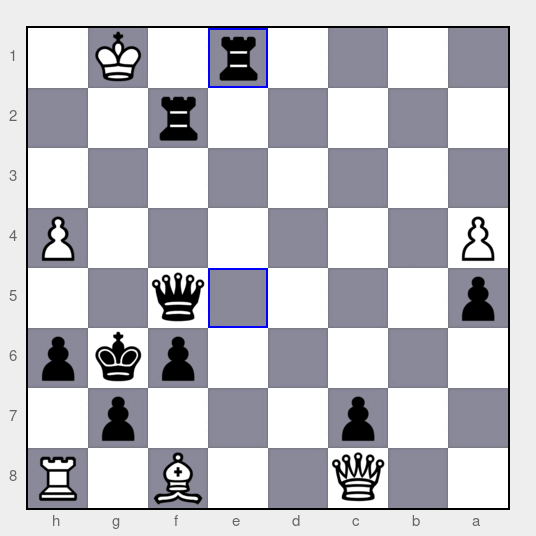
Rook, Rook, Queen Combination Checkmate.
I won this CC Club Tournament Game recently playing Black by Checkmating the White King on my 43rd move. The position of pieces at game's end is shown in the image above, and our full move record follows: 1. d4 h6 2. h4 Nf6 3. Nc3 d5 4. e3 a6 5. Nf3 Bg4 6. Bd3 Nc6 7. e4 e6 8. e5 Ne4 9. Bxe4 dxe4 10. Nxe4 Bb4+ 11. c3 Ba5 12. Nc5 O-O 13. Nxb7 Qb8 14. b4 Bb6 15. Na5 Nxa5 16. bxa5 Bxa5 17. Ba3 Bxc3+ 18. Kf1 Qb5+ 19. Kg1 Rfd8 20. Be7 Re8 21. Bc5 Bxa1 22. Qxa1 Bxf3 23. gxf3 Qd3 24. Kg2 Qg6+ 25. Kf1 Qd3+ 26. Kg2 Rab8 27. a4 a5 28. Rd1 Qg6+ 29. Kf1 Rb3 30. Qa2 Rxf3 31. d5 exd5 32. Qxd5 Rf4 33. Qd7 f6 34. Qd5+ Kh8 35. Qd7 Rxe5 36. Qc8+ Kh7 37. Rd8 Qb1+ 38. Kg2 Qg6+ 39. Kh3 Rf3+ 40. Kh2 Qf5 41. Rh8+ Kg6 42. Bf8 Rxf2+ 43. Kg1 Re1#
And the adventure continues.
Using Personal Firewalls to Block Negative Energy
from engenetics.org

First published in 2006, this article was another in the Doctor’s series on personal firewalls and their use in daily life…
This edition of The Doctor’s Notes deals with using one’s personal firewall to block unwanted negative energy. The key to doing this is pinpointing your Heisenberg center.
We’ve all felt it: times when you feel like everyone or everything is just bringing you down, whether it is social gathering, work situation or even with loved ones. The problem isn’t you, it’s the negative energy created by those around you.
Personal firewalls are the means to block the negative energy that is generated by those... who would limit the potential that we all have.
It was scientifically proven by Dr. Carl Jung that the thoughts and emotions of those around us affect each and every one of us. The key to removing this negative energy from our lives is personal firewalls.
Personal Firewalls Block Negative Energy
The concept of personal firewalls is not a new one. In recent years it has been appropriated by the Microsoft Corporation as a way of blocking unwanted network intrusions. This was never the purpose of personal firewalls. Personal firewalls are the means to block the negative energy that is generated by those around us, those who would limit the potential that we all have.
Personal firewalls are generated through our own personal wills. While this may seem logical, it is actually counterintuitive. Computer firewalls are products created by outside companies, people who do not always have your best interest in mind. Personal firewalls are generated by you, from your own mind.
I cannot understate this fact. YOU... you have the power to control your future. YOU have the power to generate your own personal firewall, to block the negative energy generated by those around you. engenetics.org can show you how.
Heisenberg Centers Are the Key
One of the cornerstones of engenetics.org is pinpointing your Heisenberg centers. Once you do this, the world opens before you... including the generation of personal firewalls.
The use of Heisenberg centers has long been a hotly disputed issue. I personally have been ridiculed by the community of Berlin psychologists because of this belief, when in reality, this is a scientifically proven fact. The evidence is there, but those in positions of authority refuse to believe it.
Regardless, the future of humanity rests with the development of personal firewalls, through the pinpointing of your Heisenberg centers. No matter what those who would keep you down might tell you, you can block the negative energy those same people generate and achieve your dreams. The key to that future is engenetics.org.
What can you do to reach this future? Join us at engenetics.org. We can teach you to pinpoint your Heisenberg centers and erect your personal firewalls, and help you be the enlightened individual you should be. Ω
Dr. M. E. Tabyánan Executive Director and Founder The Center for engenetics.org Studies
“…a growing amount of man-made sources of high level electromagnetic energy is also having an influence on our minds as well. The absolute sum of this dark energy leads all of us to behave much differently than if this energy was not present.” —The Connection Between Mental Stability and Personal Firewalls (1995)
Ask The Doctor!
Question: Is sex bad? I would hate that! —Ginger Lockwood, Los Angeles CA The Doctor: Sex is actually great! Not only does it propagate our species, but it is also a very pleasurable and intimate physical act. Care must be taken, however, because such intimacy leads to stronger probabilities of quantum entanglements. While +QEs are beneficial to the individual’s psychic well-being, -QEs are definitely to be avoided at all costs. I recommend that you come to the Center for personal training to ensure that you do not develop -QEs.
What Others Are Saying
“I was lost, now I am found!” —Christian Jones, Dallas, TX, USA
“Thank you, Doctor Tabyánan! You are directly responsible for latest promotion!” —Kenshen Suzuki, Tokyo, Japan
“I feel like I am more in tun with the spirit world, thanks to engenetics.org and Doctor Tabyánan.” —Amelia Rose, Dallas, TX, USA
#thedoctorsnotes #engenetics #personalfirewalls #heisenbergcenters
Black Friday acct deletion (??)
from  blog//x2600.cc
I woke up to see my Amazon acct was deleted. Not signed out, deleted. AI faux pas? Related to corporate espionage and mega co's using AI “agents” to sabotage other tech co's? Other foul actors?
Who knows. But I started a new acct. Same details, contact info, and am back in business.
Repopulating cart with objects I need, and then adding Lists for items needs long-term. Some things inadnt visited in a while:
Beaglebone Black SBC. I read a blog entry about someone running a server on one of these for 5+ years. OpenBSD. Was/is serving him well. Beaglebone Black still going strong
One-person yurt. A hot tent. Setting out to re-find this item, I came across a bit better one. Same company, OneTigris, but instead of an enclosed yurt (teepee), the one I settled on is a lean-to w/ mesh covering and a long awning. A wood stove chimney would peel out from the side of the awning. More open space. Easier to set up. And more versatile. Sub-$100.
Neck wallet: fairly similar to a thin, RFID blocking passport wallet, but this is larger. Capable of Passport, cards, phone, and other accessories. I can use this as an organizer within my GoRuck backpack (waterproof, the GoRuck) and then grab only the neck wallet if I need to go somewhere in a flash or a backpack is absolutely forbidden. Facial razor, phone charger, Prilosec and other items can go in here easily. Plus tobacco pipe items. Of course the passport leather wallet w/ crucial life documents and “good to have” items can fit, as well.
Just a few recently explored items. More added throughout the morning
Now, finishing coffee
The market is down
from  a.nihil
Talk to anyone who has to work for a living and this is the common complaint you will hear atleast once in a conversation “the market is down”/”the market is bad” followed by fears of AI, job loss, increased prices and unaffordable homes. This conversation can be had without cultural and geographic barriers and across all age groups, more so with the young. Yet, Anthropic debuted with the best ever IPO worth over a trillion dollars yesterday. Technology that was meant to connect people and make our lives easier has slowly inched to the point of making copyrights and human labor irrelevant, focusing on an opaque chatbot do the work as one sits back and copy-pastes the output.
The entire nature of human survival has been reduced to precarity with the hopes that it remains this way or even becomes worse, because that's what a trillion dollar valuation for an AI company signals. A world where art isn't created for fun, where reading is relegated to information extraction and everything is a dashboard for pleasure or resource maximization. It's a time of great technological upheaval, yes, but makes one wonder how life was just 30 years ago when the chains of Wi-Fi and always on communications were still not delivered to the masses.
The market is down, but only for you and me. For the super-super rich, it's an upmarket time, a time of cheap slaves and plentiful labor. A world where our voice doesn't matter as much as long as they can hunker in their bunkers and slow drip us the promise of a capitalist salvation. And all of this alone, because who can plan for a family now? Children are the ultimate status symbol in this new world economy. With families successfully pulverized and the social contract broken, we sit alone trying to consume as little as possible for the incoming doom cycle to subside. The market is down and so are we.
#market #AI #postcapitalism
Test
from Anthony Collin
Voila j’ai de quoi l’enrichir du coup.