Want to join in? Respond to our weekly writing prompts, open to everyone.
A Sickly Creature
from  Notes I Won’t Reread
Ive been throwing up a lot lately, i think theres a huge personal disagreement between me and my stomach. i dont think we agree and its turning me into a vomit bomb. an inconvenient vomit bomb. i eat something, thow it back up, drink something and throw that up as wel. im sure theres a scientific explanation for it, but im too lazy to look for one. theres blood involved. just another thing to add to the list of things that arent going well. i havent even healed from the previous incident and now ive got this to entertain me as always. yesterdays little disagreement with someones fist hasnt helped either. my head feels like its been replaced with something les functional. ive been trying to think, but its difficult when your thoughts seem to arrive in pieces. broken pieces. throwing up makes me feel attractive. actually. a very handsome vomit bomb, if you ask me. its a terrible waste of a perfectly good look, really. i dont know what ive done to deserve all this. well, i do know i do deserve this, but but but. thats beside the point. anyway, i thought that was worth mentioning.
Im getting tired of this. i cant eat properly, i can’t think properly i cant drink properly. im beginning to wonder what exactly im supposed to do with myself. sit in a corner and look decorative, maybe.
Sincerely, Your favourite narcissist.
Ontroertranen
from  Shikii
Muziek die je raakt Werken van lang geleden Ontroeren nog steeds.
EpicMonday 45: Wenn der Alltag aus dem Takt gerät
from  EpicMind

Freundinnen & Freunde der Weisheit! Viele Menschen achten auf Ernährung, Bewegung oder Schlaf, wenn es um gesundes Altern geht. Weniger beachtet wird oft ein anderer Faktor: der Rhythmus des Alltags. Neue Forschungsergebnisse deuten darauf hin, dass regelmässige Tagesabläufe einen erstaunlich engen Zusammenhang mit biologischem Altern haben könnten.
Gemeint ist damit nicht das Alter im Pass, sondern der tatsächliche Zustand des Körpers – also wie stark Organe, Zellen und Stoffwechsel bereits beansprucht sind.
Entscheidend scheint dabei nicht ein perfekter Lebensstil zu sein, sondern eine gewisse Verlässlichkeit im Tagesablauf. Menschen mit stabilen Rhythmen – etwa regelmässigen Schlafzeiten, klaren Aktivitätsphasen und ausreichenden Ruhezeiten – zeigten in Untersuchungen Hinweise auf ein langsameres biologisches Altern. Unruhige oder stark wechselnde Tagesstrukturen hingegen standen häufiger mit einer beschleunigten Alterung in Verbindung. Besonders problematisch gelten dabei dauernde Unterbrechungen, unregelmässige Schlafmuster oder ein ständiger Wechsel zwischen Aktivität und Erholung.
Das passt zu früheren Erkenntnissen aus der Schlafforschung und Chronobiologie. Unser Körper orientiert sich stark an inneren 24-Stunden-Rhythmen. Werden diese dauerhaft gestört – etwa durch Schichtarbeit, Schlafmangel oder stark wechselnde Tagesabläufe –, kann dies Entzündungen, Stressreaktionen und andere gesundheitliche Belastungen fördern. Umgekehrt scheint ein vorhersehbarer Alltag dem Körper Orientierung zu geben. Interessant ist dabei, dass es offenbar weniger um maximale Produktivität geht als um einen ausgewogenen Wechsel zwischen Belastung und Erholung.
Die Forschung steht allerdings noch am Anfang. Bisher zeigen die Daten vor allem Zusammenhänge, aber noch keine eindeutigen Ursache-Wirkungs-Beziehungen. Dennoch zeichnen sich bereits praktische Konsequenzen ab: Wer langfristig gesund bleiben möchte, sollte nicht nur auf einzelne Gewohnheiten achten, sondern auch auf den Rhythmus des eigenen Lebens. Regelmässige Schlafzeiten, bewusste Ruhephasen und ein Alltag mit einer gewissen Struktur könnten wichtiger sein, als viele bisher angenommen haben.
Denkanstoss zum Wochenbeginn
„Alt werden heißt sehend werden.“ – Marie von Ebner-Eschenbach (1830–1916)
ProductivityPorn-Tipp der Woche: Digital Detox – bewusste Offline-Zeiten schaffen
Plane bewusst Zeiten ein, in denen Du offline bist, um Dich besser zu konzentrieren und Deine Gedanken zu ordnen.
Aus dem Archiv: Wenn Loslassen klüger ist als Durchhalten
Der Morgen begann unspektakulär. Ich sass am Küchentisch, der Kaffee war noch heiss, und vor mir lag eine To-do-Liste, die mich schon länger begleitet als mir lieb ist. Einige Aufgaben habe ich in den letzten Monaten wieder und wieder übertragen. Nicht, weil sie so wichtig wären, sondern weil ich nicht bereit war, sie zu streichen. Beim Blick auf ein bestimmtes Ziel – meinen digitalen Foto-Order sortieren und ausmisten – spürte ich dieses leise Ziehen im Bauch, das sich einstellt, wenn man zwar weiss, dass etwas nicht stimmt, es aber noch nicht laut aussprechen will.
Vielen Dank, dass Du Dir die Zeit genommen hast, diesen Newsletter zu lesen. Ich hoffe, die Inhalte konnten Dich inspirieren und Dir wertvolle Impulse für Dein (digitales) Leben geben. Bleib neugierig und hinterfrage, was Dir begegnet!
EpicMind – Weisheiten für das digitale Leben „EpicMind“ (kurz für „Epicurean Mindset“) ist mein Blog und Newsletter, der sich den Themen Lernen, Produktivität, Selbstmanagement und Technologie widmet – alles gewürzt mit einer Prise Philosophie.
Disclaimer Teile dieses Texts wurden mit Deepl Write (Korrektorat und Lektorat) überarbeitet. Für die Recherche in den erwähnten Werken/Quellen und in meinen Notizen wurde NotebookLM von Google verwendet. Das Artikel-Bild wurde mit ChatGPT erstellt und anschliessend nachbearbeitet.
Topic #Newsletter
from Top Rail Fence Charlottesville
Chain Link Fence
Choose a chain link fence for basic property security and clear borders, with solid construction and professional installation for homes, businesses or farms.
from  boyquotes
100+ Life Mello Quotes to Embrace Peace, Happiness, and Simple Living
Life doesn't always have to be loud, complicated, or full of endless expectations. Sometimes, the best moments come when we slow down, breathe deeply, and appreciate the little things around us. A peaceful afternoon, a meaningful conversation, a quiet mind, or a simple smile can make life feel beautiful.
Life mello quotes capture this relaxed and thoughtful approach to living. They remind us to slow down, let go of unnecessary stress, appreciate ordinary moments, and find happiness in life's natural rhythm.
Whether you're looking for calming words, positive thoughts, or a meaningful caption for social media, these mellow life quotes can inspire you to enjoy a softer, more peaceful way of living.
Life Mello Quotes
- “Life feels better when you stop rushing through every moment.”
- “A peaceful mind makes even an ordinary day feel special.”
- “Take life slowly; beautiful things don't always need to happen quickly.”
- “Sometimes, doing less gives you room to enjoy more.”
- “Let your life flow like a gentle breeze, not a constant storm.”
- “Happiness often hides in the quiet corners of everyday life.”
- “A simple life can hold the richest moments.”
- “Slow down, look around, and notice how much beauty surrounds you.”
- “Not every moment needs a plan; some moments just need to be lived.”
- “Life becomes lighter when you stop carrying things that don't matter.”
- “Find comfort in the little things and peace in the present.”
- “Let today be simple, calm, and enough.”
- “The sweetest days are sometimes the ones without big plans.”
- “Give yourself permission to enjoy life at your own pace.”
- “A calm heart can find sunshine even on cloudy days.”
Mellow Quotes About Enjoying the Simple Things in Life
The beauty of life is not always found in extraordinary achievements. It often lives in morning coffee, warm conversations, familiar places, and moments when nothing feels urgent. These quotes celebrate the magic of simple living.
- “A little sunshine and a grateful heart can make a beautiful day.”
- “The simple things often become the memories we treasure most.”
- “Enjoy the quiet moments; they are part of what makes life meaningful.”
- “A peaceful evening is sometimes better than a thousand exciting plans.”
- “Life is sweeter when you learn to appreciate what you already have.”
- “Collect moments, not expectations.”
- “A slow morning can set the tone for a beautiful day.”
- “There is magic in ordinary days when you choose to notice it.”
- “Make room for laughter, fresh air, and things that make you feel alive.”
- “You don't need a perfect life to enjoy a beautiful moment.”
- “Let little joys become big reasons to smile.”
- “The best things in life often ask for your attention, not your money.”
- “Find beauty in familiar places and comfort in everyday routines.”
- “A life filled with small joys is a life well appreciated.”
- “Sometimes, the greatest luxury is having nothing to rush toward.”
Calm and Peaceful Life Mello Quotes
Inner peace is not about having a life without problems. It is about learning not to let every problem take control of your mind. These calm life quotes encourage patience, balance, and emotional clarity.
- “Protect your peace like it is one of life's greatest treasures.”
- “A quiet mind can hear what a noisy world cannot.”
- “Choose calmness even when life gives you reasons to worry.”
- “Peace begins when you stop fighting battles that aren't yours.”
- “Let go of what disturbs your heart and make room for what heals it.”
- “You deserve a life that feels peaceful, not constantly pressured.”
- “Breathe deeply; not everything needs to be solved today.”
- “Sometimes, the strongest response is a peaceful silence.”
- “Don't let temporary storms steal your lasting happiness.”
- “A calm soul makes room for clearer thoughts.”
- “You can care deeply without carrying every burden.”
- “Give yourself the gift of a slower, softer day.”
- “Peace grows when you stop comparing your journey with others.”
- “Let your heart rest from things you cannot control.”
- “A peaceful life begins with peaceful choices.”
Short Life Mello Quotes
Looking for short and meaningful mellow quotes? These simple lines are perfect for Instagram captions, WhatsApp statuses, journal entries, or daily reminders.
- “Slow down and enjoy life.”
- “Choose peace over pressure.”
- “Less noise, more joy.”
- “Keep life soft and simple.”
- “Breathe in peace.”
- “Let life flow.”
- “Stay calm, stay grateful.”
- “Find joy in little things.”
- “Make room for sunshine.”
- “Live gently.”
- “Peace looks good on you.”
- “Enjoy the present.”
- “Be here, be happy.”
- “Take it one day at a time.”
- “Let happiness come naturally.”
- “A softer life starts within.”
- “Small moments, big happiness.”
- “Choose a lighter heart.”
- “Keep your soul at ease.”
- “Life is better when you breathe.”
Mellow Quotes About Love and Relationships
Love doesn't always need grand gestures or dramatic words. Sometimes, it is found in comfortable silence, thoughtful actions, gentle affection, and the feeling of being understood.
- “The best love feels like a peaceful place to rest your heart.”
- “Love is beautiful when you can be yourself without fear.”
- “A gentle heart makes love feel like home.”
- “Sometimes, sitting together quietly says everything.”
- “Real affection lives in the little things people do.”
- “Love should bring comfort, not constant confusion.”
- “The right connection makes ordinary moments feel special.”
- “A peaceful relationship is built on patience and understanding.”
- “Choose someone whose presence makes your heart feel lighter.”
- “Love grows beautifully when two people give each other room to breathe.”
Mellow Quotes About Happiness and Gratitude
Happiness doesn't always arrive as a major life event. It can be a quiet realization that you have enough, a moment of laughter, or the comfort of being exactly where you are.
- “Gratitude turns ordinary moments into reasons to smile.”
- “Happiness grows when you stop waiting for everything to be perfect.”
- “A thankful heart notices beauty everywhere.”
- “Let yourself be happy without needing a special reason.”
- “Joy becomes easier to find when you appreciate what you have.”
- “A beautiful life is made of moments you choose to cherish.”
- “Smile at the little things; they make life feel full.”
- “Happiness is sometimes just a quiet mind and a warm heart.”
- “Celebrate the small victories along the way.”
- “The more you appreciate today, the richer your life becomes.”
Mellow Quotes About Life's Journey
Life moves at different speeds for everyone. You don't have to follow someone else's timeline or measure your progress against another person's achievements. These quotes remind you to trust your own journey.
- “Your journey doesn't need to look like anyone else's.”
- “Grow at your own pace; even nature takes its time.”
- “Some seasons are for blooming, while others are for resting.”
- “Life is not a race; make time to enjoy the road.”
- “Every chapter has something to teach you.”
- “You can change direction without losing your way.”
- “Trust the process, even when the destination feels far away.”
- “Give yourself time to become who you are meant to be.”
- “A meaningful journey is more important than a perfect timeline.”
- “Keep moving gently, one hopeful step at a time.”
Funny and Relaxed Mellow Life Quotes
Sometimes, the best way to enjoy life is to stop taking everything so seriously. These lighthearted quotes add a little humor to the art of slowing down.
- “My life plan today is to relax and see what happens.”
- “Doing nothing is an underrated weekend achievement.”
- “I'm not lazy; I'm simply moving at a peaceful speed.”
- “Some days, my biggest accomplishment is getting comfortable.”
- “Life is short, so take the scenic route and bring snacks.”
- “My favorite exercise is walking away from unnecessary stress.”
- “A quiet day and a full fridge sound like a perfect plan.”
- “I'm currently accepting invitations to peaceful places and good food.”
- “Less drama, more pajamas.”
- “If relaxing were a profession, I'd be highly qualified.”
Life Mello Quotes for Instagram Captions
Want to share a peaceful mood with your followers? These mellow captions are ideal for pictures of sunsets, nature, coffee, quiet mornings, travel, and everyday moments.
- “Living softly, dreaming freely.”
- “A little peace goes a long way.”
- “Finding my rhythm and enjoying the ride.”
- “Sunshine, slow days, and a grateful heart.”
- “Making memories without rushing the moments.”
- “Keeping things simple and my heart happy.”
- “Just enjoying where life takes me.”
- “A peaceful mood for a beautiful day.”
- “Less worrying, more living.”
- “Taking life one beautiful moment at a time.”
Final Thoughts on Life Mello Quotes
A mellow life isn't necessarily a life without challenges. It's a life where you make space for peace, appreciate simple pleasures, and refuse to let constant pressure define your happiness.
These life mello quotes offer gentle reminders to slow down, value meaningful relationships, practice gratitude, and enjoy the present moment. You don't need to change everything overnight. Sometimes, a calmer life begins with one small choice: taking a deep breath, letting go of an unnecessary worry, or making time for something you love.
If you enjoy thoughtful words about life, explore more inspiration in our collection of Life Deep Quotes. You'll find more meaningful quotes to reflect on life's lessons, emotions, and deeper experiences.
Remember:Life doesn't have to be perfect to be beautiful. Slow down, appreciate what you have, and let yourself enjoy the journey.
from boyquotes
100+ Life Is Messy Quotes to Embrace Imperfection and Find Happiness
Life is messy, unpredictable, and full of unexpected twists and turns. Sometimes things go according to plan, while other times everything seems to fall apart at once. We experience happiness and heartbreak, success and failure, love and disappointment. But that's what makes life real and meaningful.
The truth is that nobody has a perfectly organized life. We all make mistakes, face challenges, experience difficult emotions, and struggle to figure things out along the way. Instead of waiting for everything to become perfect, we must learn to embrace the imperfections and appreciate the beauty of our imperfect journeys.
If you're looking for words that remind you to accept life's ups and downs, you're in the right place. We've collected the best life is messy quotes about imperfection, happiness, struggles, love, and personal growth to inspire you to keep moving forward, even when life gets complicated.
Life Is Messy Quotes
Life doesn't always follow a straight path. Sometimes the unexpected moments teach us the most valuable lessons. These quotes remind us that having a messy life doesn't mean having a bad life.
- Life is messy, but that's where the most beautiful stories begin.
- Nobody has it all figured out, and that's perfectly okay.
- Life is not meant to be perfect; it's meant to be lived.
- Sometimes the messiest chapters lead to the most beautiful endings.
- Life gets complicated, but every challenge brings an opportunity to grow.
- Embrace the mess because perfection was never the goal.
- A messy life can still be a beautiful life.
- Life is a collection of imperfect moments that create a perfect story.
- You don't need to have everything together to enjoy where you are.
- Sometimes you have to get lost in the mess to discover who you really are.
- Life is unpredictable, and that's part of its beauty.
- The beauty of life isn't in its perfection but in its imperfections.
- Don't wait for life to become perfect before allowing yourself to be happy.
- Even the most beautiful gardens have a little dirt.
- Life may be messy, but every day gives us another chance to make it meaningful.
Life Is Messy but Beautiful Quotes
There is beauty in the imperfect moments of life. The unexpected laughter, difficult lessons, unforgettable memories, and little victories make our journey special.
- Life is messy, complicated, and sometimes heartbreaking, but it is still beautiful.
- The most beautiful things in life are rarely perfect.
- Behind every messy moment, there is a story worth remembering.
- Life doesn't have to be flawless to be wonderful.
- Sometimes the chaos of life creates the most beautiful memories.
- A beautiful life is not a perfect life; it's a life filled with love and meaning.
- Even on the messiest days, there is something worth being grateful for.
- Life is beautiful because it is unpredictable, imperfect, and full of surprises.
- The cracks in your story allow the light of experience to shine through.
- Find beauty in the chaos and happiness in the little things.
Life Is Messy Quotes About Love
Love is one of the most beautiful yet complicated parts of life. Relationships are not always easy. They involve misunderstandings, disagreements, compromises, forgiveness, and countless emotions. But genuine love means accepting imperfections and choosing to grow together.
- Love is messy, but finding someone who makes the mess worthwhile is beautiful.
- Real love isn't about finding a perfect person; it's about accepting an imperfect human being.
- Relationships are messy because real emotions are never simple.
- Love means choosing each other even when life becomes complicated.
- The best relationships aren't perfect; they are built on honesty, patience, and understanding.
- Sometimes love is messy, but it teaches us the most beautiful lessons.
- Love doesn't need perfection; it needs commitment and kindness.
- A beautiful relationship is made of two imperfect people who never stop trying.
- Life gets messy, but love gives us a reason to keep believing.
- The right person won't expect you to have a perfect life; they will accept your imperfect journey.
Life Is Messy and That's Okay Quotes
We often put unnecessary pressure on ourselves to have everything figured out. We want perfect careers, successful relationships, financial stability, and happy lives. However, life rarely works according to our expectations.
These quotes remind us that it's okay to struggle, make mistakes, and take things one day at a time.
- Life is messy, and that's okay. You are allowed to figure things out as you go.
- You don't have to be okay every single day.
- It's okay to have a bad day without believing you have a bad life.
- Some days you make progress; other days you simply survive. Both matter.
- Stop expecting yourself to have all the answers.
- It's okay if your life doesn't look like everyone else's.
- Give yourself permission to be imperfect.
- You are still growing, even when everything feels uncertain.
- Don't be too hard on yourself for being human.
- Sometimes accepting the mess is the first step toward finding peace.
Messy Life Quotes About Personal Growth
Personal growth is rarely a smooth journey. It involves mistakes, disappointments, difficult decisions, and moments when we question ourselves. But every experience can teach us something valuable.
- Growth is messy, uncomfortable, and absolutely worth it.
- You cannot become a stronger person without facing a few difficult moments.
- Every mistake is an opportunity to learn something new.
- Sometimes life has to fall apart before you discover what truly matters.
- Your messy past doesn't determine your beautiful future.
- Progress isn't always pretty, but it is always meaningful.
- The person you are becoming is worth every difficult lesson.
- Don't confuse a difficult chapter with the end of your story.
- Every setback carries a lesson that can make you wiser.
- Becoming yourself is a lifelong journey, and it won't always be easy.
Life Is Messy but Worth Living Quotes
Even when life feels overwhelming, there are countless reasons to keep going. The people we love, the dreams we pursue, the experiences we share, and the beautiful moments we haven't experienced yet make life worthwhile.
- Life is messy, but every sunrise gives us another reason to try.
- Even when everything feels uncertain, life is still worth living.
- There is always something beautiful waiting beyond a difficult day.
- Life may break your plans, but it can also create unexpected opportunities.
- Don't give up on life just because today feels difficult.
- The best moments often arrive when you least expect them.
- Life is worth celebrating, even when it doesn't go according to plan.
- Every new day is an invitation to begin again.
- Sometimes the smallest moments become the greatest memories.
- Keep going because your story is still being written.
Short Life Is Messy Quotes
Looking for short and meaningful quotes for Instagram captions, Facebook posts, or personal reflections? These simple sayings capture the beauty of living an imperfect life.
- Life is messy. Embrace it.
- Perfectly imperfect, beautifully human.
- Messy life, beautiful soul.
- Chaos is part of the journey.
- Life happens. Keep growing.
- Imperfection makes life interesting.
- Beautiful things grow through messy seasons.
- No perfect life, just real moments.
- Finding beauty in the chaos.
- Life is messy, love it anyway.
- Progress over perfection.
- Messy days, meaningful lessons.
- Real life isn't picture-perfect.
- Let life be beautifully imperfect.
- A little chaos makes a great story.
Funny Life Is Messy Quotes
Sometimes the best way to deal with life's chaos is to laugh about it. Humor helps us see the lighter side of difficult situations and reminds us not to take ourselves too seriously.
- My life isn't a mess; it's a creative arrangement of unexpected events.
- Life is messy, and apparently, I'm the main character in the chaos.
- I had a plan, but life decided to write its own script.
- My life is like a puzzle with several missing pieces and no instructions.
- I'm not disorganized; I'm just living an unpredictable adventure.
- Life is messy, but at least I'm entertaining.
- I don't have everything together, but I have snacks.
- My life needs a reset button and possibly a user manual.
- Some people have their lives together. I'm just happy when I find my keys.
- Life is too short to pretend that everything is under control.
Inspirational Quotes About Embracing Imperfection
One of the greatest lessons life teaches us is that perfection is not necessary for happiness. Accepting our flaws, celebrating our progress, and learning to love ourselves can make life more fulfilling.
- Your imperfections are part of what makes you unique.
- Stop comparing your messy beginning to someone else's polished success.
- Happiness begins when you stop demanding perfection from yourself.
- Embrace your flaws because they are part of your story.
- You are worthy of love and happiness, even on your most imperfect days.
- Life becomes easier when you learn to accept what you cannot control.
- Don't let the pursuit of perfection steal the joy of the present.
- Be proud of how far you've come, even if the journey was messy.
- Your life doesn't need to look perfect to be meaningful.
- Sometimes the most important thing you can do is simply keep going.
Final Thoughts
Life is messy, and that's something we all need to accept. There will be days when everything feels confusing, plans fall apart, and nothing seems to go the way we hoped. But those moments don't make our lives any less meaningful.
The secret to enjoying life isn't having everything perfectly organized. It's learning to appreciate the good moments, accept the difficult ones, forgive yourself for your mistakes, and keep moving forward.
We hope these “life is messy quotes” remind you that you don't need a perfect life to be happy. Embrace your imperfections, find beauty in unexpected places, and remember that even the messiest journeys can lead to wonderful destinations.
Life is messy. Life is unpredictable. Life is imperfect. And that's what makes it beautiful.
Day 151
from Out of Office
Well, I already finished the rewatch. I have never had a show hold such a chokehold on me, but wow, I am ready for round 3.
I have about 20 days before the move and still have so much to finish and do. I did not get a lot done today, shocking, but I have ambitious plans for tomorrow. I have to get rid of so much crap. How do I get rid of things I’m sentimentally attached to? I am seriously struggling with it.
I need to come up with a game plan tomorrow so that I can get back on track.
Thank you for your message. I am currently out of office — but will return at the end of the month.
AI and the Graduate Premium: Knowledge Gets Cheaper, Judgement Gets Dearer
from  SmarterArticles

Half a percentage point. That is how much a year of schooling has lost in wage value, in the American occupations most exposed to generative AI, since ChatGPT arrived in November 2022. It sounds like a rounding error. It is not. It is one of the first direct estimates of something economists have suspected for three years: the machine is coming for the part of your education that can be written down.
The number comes from a working paper posted to arXiv on 26 October 2026 by Eduardo Levy Yeyati, Darío Judzik and Juan Ignacio Barbiero of Universidad Torcuato Di Tella in Buenos Aires. It is titled “Practice Makes Perfect: Tacit Knowledge, Generative AI, and Returns to Schooling and Experience”, and it does something deceptively simple. It takes the workhorse equation of labour economics, the one that tells you how much an extra year in a classroom or an extra year on the job adds to your pay, and asks whether its coefficients moved when large language models went mainstream.
They did. In highly exposed occupations, the return to a year of schooling fell by 0.55 log points, roughly 7 per cent of what it had been. The return to experience did something stranger. It did not rise or fall uniformly. It rotated, like a seesaw. Early-career experience became more valuable. Late-career experience became less so. The pivot sits at about 18 years.
Put that next to two other pieces of 2026 research and a picture forms. PwC's Global AI Jobs Barometer, built from more than a billion job advertisements, finds the labour market splitting into two tracks, with the jobs where AI raises the bar for expertise growing twice as fast as the jobs where AI lowers it. And a field experiment led by the MIT economist David Autor finds that when patent lawyers trained alongside an AI assistant were later asked to work without it, the senior lawyers kept their gains while the juniors, on average, did not.
Together, the three studies describe a repricing. Codified knowledge, the stuff a degree certifies, is getting cheaper because a machine can supply it on demand. Tacit judgement, the stuff you only get by doing the work, is getting dearer, but it has a shelf life. For anyone who has just borrowed tens of thousands to buy a credential, that is uncomfortable news. Read carefully, it is also not the catastrophe the headline numbers suggest.
Seven and a Half Points a Year
To understand what moved, you need to know what was being measured. In 1974 the Columbia economist Jacob Mincer published “Schooling, Experience, and Earnings”, a slim book from the National Bureau of Economic Research that gave the discipline its workhorse. Mincer's insight was that if you take the logarithm of a person's earnings, you can model it as a straight-line function of their years of schooling plus a curved function of their years of work experience. The curve is concave: experience pays a lot early, then the gains flatten as people stop investing in new skills.
The schooling coefficient has an intuitive reading. Because the left-hand side is in logs, a coefficient of 0.075 means each additional year of school is associated with roughly 7.5 per cent higher hourly pay, holding experience constant. Economists call that 7.5 log points. Half a century of refinement later, it remains the default lens for asking what education is worth.
This matters for reading the new paper correctly, because the units are easy to garble. Levy Yeyati and his colleagues report that before ChatGPT, the return to a year of schooling in the most AI-exposed occupations was 7.5 log points. In the least exposed occupations it was just 1.7. After the release, the exposed-group figure fell by 0.55 log points relative to the control group. That does not mean wages fell by 0.55 per cent, nor that the degree premium collapsed by 7 per cent of your salary. It means the slope of pay against schooling flattened, from roughly 7.5 points per year to roughly 7 points per year. The 7 per cent figure is the decline in that slope relative to where it started: 0.55 divided by 7.5 is about 7.3 per cent.
A rough illustration helps. A four-year degree in a highly exposed occupation was previously associated with about 30 log points more pay than a high school diploma, all else equal (four years at 7.5 points each). At the post-shock rate, that becomes about 28 points. That arithmetic is mine, not the authors', and it ignores everything else that changed, but it conveys the order of magnitude. The degree still pays. It pays a little less, and in exactly the places where the technology bites hardest.
How a Degree Lost Half a Point
The study draws on the US Current Population Survey's outgoing rotation groups, the monthly household survey that asks a subset of respondents about their earnings. The authors use data from 2018 through June 2026, covering 655,919 observations of people aged 16 to 64 with a valid hourly wage. They date the shock to November 2022 and organise their years from November to October so that the ChatGPT release falls cleanly on a boundary.
To decide which occupations count as exposed, they use an index built by Edward Felten, Manav Raj and Robert Seamans and published in the Strategic Management Journal in 2021. Crucially, that measure predates ChatGPT, so it cannot have been contaminated by what happened afterwards. The paper compares occupations in the top quartile of exposure, which include software developers, financial managers and lawyers, with those in the bottom quartile, which include truck drivers, construction labourers and waiters. The middle two quartiles are set aside.
The core specification is a Mincer equation with the schooling and experience terms interacted with two switches: whether the occupation is exposed, and whether the observation comes after the release. The authors control for a long list of demographic and job characteristics, with fixed effects for month, state and occupation.
One technical choice deserves attention because it affects the result. High earners in the survey are top-coded: above a certain threshold, the Census Bureau records a cap rather than the true figure. That cap changed in April 2023, from a fixed value to a dynamic one, which happens to fall in the post-shock window. Top-coding is concentrated in the treated occupations: 11.5 per cent of that group is censored, against 0.7 per cent of the controls. The authors handle it with interval-censored maximum likelihood rather than imputation, and they test alternatives. Applying the pre-2023 cap throughout gives a schooling effect of minus 0.53 log points, almost identical to the headline. But a deliberately harsh check, which treats dynamically top-coded observations as exact values, shrinks the schooling estimate to minus 0.09. The authors flag this openly. It is the most important caveat in the paper, and anyone quoting the 0.55 figure should know it exists.
Other checks are reassuring. The pre-release schooling coefficients show no trend, and the break appears in the first year after release. A placebo that re-dates the shock to January 2020, to test whether the pandemic is doing the work, finds nothing. Dropping the technology sector “does little”. Swapping the Felten exposure index for the “GPTs are GPTs” measure developed by Tyna Eloundou and colleagues at OpenAI and the University of Pennsylvania gives a schooling decline of 0.42 log points, close to the baseline.
Experience Turns on a Hinge at Eighteen Years
The schooling result is the headline, but the experience result is stranger. In a standard Mincer setup, the value of an extra year of experience depends on how much you already have. A third year adds more than a twenty-third. What Levy Yeyati, Judzik and Barbiero find is that the shape of that curve changed after November 2022 in exposed occupations. At three years of potential experience, the return to an additional year rose by 0.26 log points. At five years, it rose by 0.23. At fifteen, the change is statistically indistinguishable from zero. At twenty-five years, it fell by 0.12. Under the baseline quadratic specification, the effect crosses zero at 18.1 years, with a standard error of 2.1.
The authors are careful about what this means. It is a change in the slope of the experience profile, not a statement that workers with 18 years of experience are the break-even point for winners and losers in pay. “Potential experience” is also a blunt instrument: it is simply age minus years of schooling minus six. It counts time since leaving education, not time spent doing the tasks AI now touches.
The heterogeneity analysis sharpens the picture. Among workers with an associate degree or higher, the early-career return rises by 0.43 log points at three years, and the late-career return falls by 0.12 at twenty-five. Among workers without a credential, the early gain is smaller and the late decline is not statistically significant. In other words, the rotation is strongest precisely among people who hold formal qualifications. The authors write that “wage differences by early-career experience become steeper after the shock” within that credentialed group.
Finally, the level effect. For a worker with 16 years of schooling and 15 years of experience in a treated occupation, the estimated wage change is minus 3.2 log points. That is a real cut, and it falls on exactly the profile of a mid-career graduate professional. But the authors stress that the level effect “is not itself a theoretical prediction”, and they say plainly that “the findings are not a forecast of long-run returns to education or experience.”
Codified Knowledge Was Always the Cheap Part
The theory behind the paper rests on an old distinction. In 1966 the chemist and philosopher Michael Polanyi published “The Tacit Dimension”, which contains the line “we can know more than we can tell.” Some knowledge can be written down, taught in lectures and tested in exams. Some can only be acquired by doing: the feel for when a contract clause will cause trouble, the instinct for which bug report is really an architecture problem, the sense of when a patient's symptoms do not add up.
In 2014 David Autor borrowed Polanyi's line for an NBER working paper titled “Polanyi's Paradox and the Shape of Employment Growth”. His argument was that computers had automated tasks that could be specified as explicit rules, and had struggled with tasks requiring tacit knowledge. That pattern, he argued, explained why employment had grown at the top and bottom of the wage distribution and hollowed out in the middle.
Generative AI scrambles that story. Large language models are not programmed with rules; they learn from enormous quantities of text, absorbing much of what humanity has managed to write down. They are, in effect, machines for supplying codified knowledge at near-zero marginal cost. Ask one to explain the doctrine of equivalents in patent law or the assumptions behind a discounted cash flow model, and it will usually produce a competent answer in seconds.
The Levy Yeyati model formalises three consequences. First, substitution: machine and worker codified knowledge are treated as perfect substitutes, so when the machine version becomes abundant, the worker version, proxied by schooling, loses scarcity value. Second, complementarity: practice-based judgement becomes more valuable when the codified knowledge it works on gets cheaper, steepening the early-career slope. Third, obsolescence: experience tied to the old way of doing the work loses value when the technology changes, flattening the late-career slope.
The paper concedes its estimates do not separately identify these mechanisms. The pattern is consistent with all three acting together, but does not prove it. Nor does the paper distinguish fields of study or institutional quality. A year of organic chemistry and a year of media studies count the same.
A Labour Market Splitting in Two
If the Levy Yeyati paper measures what workers are paid, PwC's 2026 Global AI Jobs Barometer measures what employers are asking for. Released on 15 June 2026, it analyses more than one billion job advertisements across 27 countries and territories on six continents.
Its central finding is a fork. In some occupations, which PwC calls professionalised, AI automates the routine parts of the job and pushes the remaining human work towards judgement and expertise. PwC's examples include radiologists and recruiters. In others, which it calls democratised, AI makes the work easier for non-experts to perform, lowering skill barriers and shifting roles towards less specialised activity. Its examples include IT service managers and medical secretaries.
According to PwC Belgium's release of the global results, “the 22% of jobs that are being professionalised are growing twice as fast as democratised jobs (52% of jobs)”, while “seeing 42% higher wage growth since 2021.”
Read alongside the earnings data, this is striking. The democratised track looks like the substitution story: AI takes over the codified core of a job, and the premium for having learned it shrinks. The professionalised track looks like complementarity: AI clears away routine work and leaves a residue of judgement that commands a premium. That the professionalised track is smaller but faster growing and better paid fits the idea that value is migrating towards tacit expertise.
PwC also reports that the average wage premium for AI skills in job postings rose to 62 per cent, from 57 per cent the previous year. Pete Brown, PwC's Global Workforce Leader, put the implication directly: “Organisations need to rethink how they develop talent if they want people to thrive in this new environment.”
Job advertisements capture what employers say they want, not what they pay individual workers, and PwC sells AI advisory services. Its findings are a large signal about demand, not a peer-reviewed causal estimate.
Junior Jobs That Ask for Senior Skills
The most pointed PwC finding concerns the bottom rung. Analysing 2.4 million entry-level job postings in the United States, the barometer finds that junior roles highly exposed to AI are seven times more likely to require “traditionally senior skills”, such as leadership and strategic thinking, than entry-level roles that are not exposed. Some accounts express this as 52 per cent of new skills against 7 per cent. That ratio fits the sevenfold headline, but the breakdown does not appear in PwC's public summaries, so the sevenfold figure is the safer one to quote.
Openings for these “seniorised” roles have grown 35 per cent since 2019, while other entry-level openings have fallen 10 per cent. The entry-level job is being redefined: employers want new hires who can do on day one what used to take years to learn.
Other data point the same way. Erik Brynjolfsson, Bharat Chandar and Ruyu Chen of Stanford's Digital Economy Lab have been tracking employment using payroll data from ADP, the largest payroll processor in the United States. Their paper “Canaries in the Coal Mine? Six Facts about the Recent Employment Effects of Artificial Intelligence”, first released in August 2025 and revised on 12 August 2026 with data through June 2026, finds no evidence of widespread, economy-wide job displacement. But employment of workers aged 22 to 25 in AI-exposed occupations is now 19 per cent below where it would be had it kept pace with less exposed peers. Experienced workers show no comparable gap. The adjustment works mainly through reduced hiring of young people rather than layoffs, and it is concentrated where AI substitutes for human tasks rather than complementing them.
The Federal Reserve Bank of New York's tracker of the labour market for recent college graduates tells a similar story. In the third quarter of 2026, the unemployment rate for recent graduates eased to 5.2 per cent, but the underemployment rate, the share working in jobs that do not typically require a degree, rose to 42.5 per cent.
There is an apparent paradox here. If early-career experience is becoming more valuable, why are young people finding it harder to get hired? The Levy Yeyati paper measures returns among people who are employed. Once you are in the door, each year of practice is worth more than before. But the door is narrower, because the entry-level job, where codified knowledge was traditionally converted into judgement, is exactly what AI is eroding. The authors note that changes in who gets employed could partly explain their early-career estimates. The premium on early experience and the shortage of early jobs may be two faces of the same scarcity.
The Patent Attorneys Who Kept Their Gains
Which brings us to the most direct test of whether AI helps or hinders the acquisition of judgement. In September 2026 the NBER released working paper 35720, “Does AI Assistance Enhance or Erode Expertise? Evidence from a Three-Month Field Experiment in Patent Drafting”, by David Autor, Tanya Rodchenko, Josh Martin, Zanna Iscenko, Scott Strand, David Pearl and Melissa Ferere. A revision followed in October.
The design is unusually clean for a workplace study. In a pre-registered randomised controlled trial, 133 practising patent lawyers at eleven US intellectual property firms were split into groups, with roughly two-thirds given access to a custom AI patent drafting assistant. Blinded expert patent attorneys scored all the work. The researchers measured performance with the tool and then, after three months, tested everyone on a core professional task without it: redlining an existing patent application.
With the tool, everyone got better. AI access raised the quality of work on benchmark drafting tasks by 0.34 standard deviations at 10 days and 0.38 at 90 days, with larger gains among junior lawyers. Dennis Crouch, the University of Missouri law professor who writes the Patently-O blog, noted that much of the improvement came from “avoiding awful work” rather than producing the very best applications.
Without the tool, the picture split. Treated lawyers outperformed controls by 0.32 standard deviations on the unaided redlining task. But that advantage came entirely from senior lawyers, whose gain was 0.45 standard deviations. Junior lawyers showed no average improvement. Their scores spread out: mediocre results became much less common, while both poor and good results became more common. The authors describe AI as acting as a “springboard” for some juniors and a “cushion” for others. Their conclusion is a sentence worth pinning above every graduate trainee's desk: “Foundational expertise may be a prerequisite for extracting durable skill from AI-assisted practice.”
Autor summarised the result to Fortune in a phrase: AI is “a performance equalizer, but a skill-disequalizer.” He added a warning aimed squarely at people starting out: “Young professionals need to beware of the illusion of competence.” Junior lawyers given the tool reported a surge in task satisfaction, the largest effect in the study. They enjoyed skipping the blank page and moving straight to a reviewer's role. The danger is that the satisfaction of reviewing a competent draft is not the same as acquiring the ability to produce one.
The caveats are substantial, and Fortune's reporting set them out. The paper is not peer-reviewed. Only 91 of the 133 lawyers completed the AI-free test. The firms declined a baseline skills test, so skill gains are inferred from random assignment rather than measured before and after. Fifteen of the 91 markups were flagged as possibly AI-assisted despite the ban; excluding them shrinks the senior advantage to 0.39 standard deviations at a looser statistical threshold, and the overall effect no longer holds. Five of Autor's co-authors are full-time Google employees and the sixth is a paid Google contractor, Google conducted and paid for the study, and the tool was Google's own. Autor is head of MIT's economics department and a Google Technology and Society Visiting Fellow. Three months is short compared with the years it takes to make a patent lawyer.
Still, the result rhymes with others. Erik Brynjolfsson, Danielle Li and Lindsey Raymond's study of more than 5,000 customer-support agents, published in the Quarterly Journal of Economics in 2025, found that AI assistance raised productivity by 15 per cent on average, with the biggest gains for less experienced and lower-skilled workers, while the most experienced saw small gains in speed and small declines in quality. And a field experiment by Hamsa Bastani and colleagues, published in the Proceedings of the National Academy of Sciences in 2025, found that Turkish high school students given unrestricted access to GPT-4 during maths practice scored 17 per cent lower once the tool was taken away, compared with students who never had it. A version with learning-protective guardrails largely mitigated the harm.
The pattern across all three is consistent. AI lifts novice performance in the moment. Whether it builds novice capability over time depends on what the novice already knows and how the tool is used.
Why Experience Expires
The other half of the rotation, the falling return at 25 years, connects to a literature on skill obsolescence that predates generative AI. In 2020 David Deming of Harvard and Kadeem Noray published “Earnings Dynamics, Changing Job Skills, and STEM Careers” in the Quarterly Journal of Economics. Using job vacancy data from Burning Glass Technologies covering 2007 to 2019, they showed that the earnings premium for graduates in technology-intensive subjects such as computer science, engineering and business declines rapidly as they gain experience.
Their model treats a career as a race between on-the-job learning and skill obsolescence. In fast-changing fields, the specific skills a graduate brings are replaced within a few years, which lowers the return to experience and flattens the age-earnings profile. Higher-ability STEM graduates also tend to leave STEM careers more often and at younger ages.
Generative AI may be turning a phenomenon that was confined to technology-intensive careers into something more general. If a large share of codified knowledge in law, finance, marketing and software is now supplied by a machine, then the experience of having done those tasks the old way may depreciate across the board. The Levy Yeyati paper's late-career finding is consistent with that reading, though the authors place less weight on individual late-career coefficients because the pre-trend test for them is weaker.
Here is the double bind for someone starting out. Early experience matters more than ever, because judgement is what AI cannot yet supply. But that experience may itself be technology-specific, and if the technology keeps shifting, its value will erode too. The patent lawyer study suggests one way out: seniors who already had deep foundations were able to absorb the new tool and come out stronger. Experience did not simply expire. It compounded, for those who had enough of it to build on.
The Debt Was Priced for a Different Market
None of this would matter so much if degrees were cheap. They are not. In the United States, Federal Student Aid reported in September 2026 that 42.3 million recipients hold federal student loans totalling more than $1.7 trillion. More than 9.3 million are in default, owing $234 billion. In England, the Student Loans Company's 2025-26 statistics put the higher education loan balance at £294.6 billion, and the provisional average balance for borrowers entering repayment in 2026 is £47,730. The House of Commons Library projects the outstanding balance could reach around £500 billion, in 2025-26 prices, by the late 2040s.
Those debts were taken on at prices set for a labour market in which the return to schooling was stable. If the premium is now shrinking in the fields most exposed to AI, the implied return on that investment shrinks with it. A loan agreement does not reprice when the asset it financed does.
It is worth being precise about the scale. A decline of roughly 0.55 log points per year of schooling, or 3.2 log points at the paper's illustrative mid-career profile, is a meaningful cut but not an annihilation. Even after the shock, the return to schooling in exposed occupations, roughly 7 points per year, remains far higher than the 1.7 points in the least exposed occupations. A degree is still associated with substantially higher pay. What has changed is the direction of travel and the reason for the premium. The share of the premium attributable to knowing things is falling. The share attributable to being able to do things is rising.
England's income-contingent repayment partly cushions graduates, because repayments fall when earnings do; many American borrowers have less protection. Either way, the risk sits with the person least able to diversify it: a young worker with a single human-capital asset and a large liability attached.
What the Numbers Do Not Say
First, the Levy Yeyati paper is a working paper, not yet peer-reviewed, and its headline schooling estimate is sensitive to how top-coded wages are treated. Its central identifying assumption, that greater exposure means a larger expansion of machine-supplied codified knowledge, is assumed rather than tested. The authors list possible confounds candidly: changes in who is employed, signalling and employer learning, and post-2022 shifts in worker composition.
Second, years of schooling are a crude proxy for codified knowledge. A degree also signals persistence, conscientiousness and the ability to learn. It provides networks, and it often functions as a legal or professional gatekeeper. None of those functions is obviously diminished by a chatbot, and the paper cannot separate them.
Third, each of the other studies has its own blind spots, from the Autor experiment's single tool to the descriptive nature of the payroll data. Their convergence is more persuasive than any one result.
Fourth, all of this describes the first three and a half years of a technology that is still changing quickly. The Levy Yeyati authors call their results a short-run repricing of existing stocks of human capital. Over the longer run, schooling choices, curricula, mentoring, occupational sorting and the organisation of entry-level work will all adjust. They close by asking “whether workers can continue to acquire the practice-based knowledge” that AI increasingly substitutes for in learning itself.
Building Judgement Without the Apprenticeship
So how should someone at the outset of a career think about a credential? The evidence suggests five principles, none of them comfortable.
Treat the degree as a foundation, not a product. Senior patent lawyers extracted durable skill from AI because they had foundations to build on, and the authors' conclusion that foundational expertise “may be a prerequisite” is an argument for deep formal education, not against it. What loses value is the degree as a certificate of facts possessed. What retains value is the degree as scaffolding for judgement. The goal is not to memorise what a model can recite, but to understand a field well enough to know when the model is wrong.
Test yourself without the tool. Autor's advice to Fortune was that the only reliable check on skill development is performing tasks without AI and evaluating the results. The Bastani study points the same way: students who used unrestricted GPT-4 as a crutch did worse once it was gone. If your employer gives you an AI assistant, the most valuable thing you can do for your own career may be to periodically do the work without it and compare.
Hunt for the practice, not just the job. Returns to early-career experience are rising while early-career hiring is falling. The scarce resource is not the qualification but the chance to convert it into judgement through supervised real work. Roles offering genuine apprenticeship, with feedback from experienced people on tasks that matter, are worth more than their starting salaries suggest.
Lean towards the professionalised track. Ask whether AI in a given role raises the bar for human expertise or lowers it. Roles where the machine handles the routine and leaves you the hard calls are growing faster and paying better. The question applies to specific jobs and employers, not just titles.
Plan for your experience to expire. Technology-specific know-how depreciates, so the defence is to keep renewing it, layering new techniques onto durable understanding, as the senior patent lawyers did, rather than swapping one set of specific skills for another.
For employers, the implication is sharper. Cutting entry-level hiring because AI can do the junior work is a decision to stop producing senior people. The juniors whose outcomes spread out in both directions in the Autor experiment are next decade's senior lawyers, or not.
A Credential Worth Holding, Priced Differently
What does it mean when the wage premium for education shrinks in the fields most exposed to the technology? The honest answer is that the premium was always paying for two things at once, and the market has started to separate them.
One part paid for possessing codified knowledge, and that part is falling, because a machine can now produce it in seconds. The other part paid for the capacity to learn, judge and build on that knowledge, and that part is holding up, perhaps rising, for those who get the chance to exercise it. The degree you paid for is not worthless. Its price has been revised, and the reason it is valuable has shifted from what it certifies you know to what it enables you to become.
For the worker carrying the debt, that is cold comfort, because the debt did not reprice. For the person deciding whether to start, it is a clearer guide than the noise suggests. The credential still pays, most of all to those who treat it as the start of an apprenticeship rather than the end of an education. Half a percentage point is a warning, not a verdict. The 18-year hinge is a reminder that judgement, too, has a shelf life, and the only defence is to keep building it.
References and Sources
- Levy Yeyati, Eduardo; Judzik, Darío; Barbiero, Juan Ignacio. “Practice Makes Perfect: Tacit Knowledge, Generative AI, and Returns to Schooling and Experience.” arXiv:2610.36008 [econ.GN], submitted 26 October 2026. Also circulated as Universidad Torcuato Di Tella, Escuela de Gobierno, Documento de Trabajo 2026/15. https://arxiv.org/abs/2610.36008 (HTML full text: https://arxiv.org/html/2610.36008)
- Autor, David; Rodchenko, Tanya; Martin, Josh; Iscenko, Zanna; Strand, Scott; Pearl, David; Ferere, Melissa. “Does AI Assistance Enhance or Erode Expertise? Evidence from a Three-Month Field Experiment in Patent Drafting.” NBER Working Paper No. 35720, September 2026, revised October 2026. https://www.nber.org/papers/w35720 (also SSRN abstract 7426447: https://papers.ssrn.com/sol3/papers.cfm?abstract_id=7426447)
- Crouch, Dennis. “Who Keeps the Skill: A Randomized Trial of AI Patent Drafting at Eleven Firms.” Patently-O, 9 September 2026. https://patentlyo.com/patent/2026/09/who-keeps-the-skill-a-randomized-trial-of-ai-patent-drafting-at-eleven-firms.html
- Lichtenberg, Nick. “The economist behind the 'China shock' tackles Gen Z's AI paradox.” Fortune, 10 October 2026. https://fortune.com/2026/10/10/david-autor-china-shock-nber-google-paper-illusion-of-competence-gen-z/
- PwC. “AI reshapes global labour market into two distinct paths, rewarding human skills: PwC 2026 Global AI Jobs Barometer.” Press release, London, 15 June 2026. https://pwc.com/gx/en/news-room/press-releases/2026/pwc-2026-ai-jobs-barometer.html (syndicated copy: https://kyodonewsprwire.jp/release/202606150856)
- PwC. “2026 Global AI Jobs Barometer: Global Findings.” June 2026. https://www.pwc.com/gx/en/issues/artificial-intelligence/job-barometer/2026/2026-global-ai-jobs-barometer-global-findings.pdf
- PwC Belgium. “AI reshapes labour market and urges for upskilling: PwC's AI Jobs Barometer 2026.” Press release, Diegem, 15 June 2026. https://press.pwc.be/ai-reshapes-labour-market-and-urges-for-upskilling-pwcs-ai-jobs-barometer-2026
- Katanich, Doloresz. “Human skills increasingly in demand as AI reshapes labour market, PwC finds.” Euronews, 16 June 2026. https://euronews.com/business/2026/06/16/human-skills-increasingly-in-demand-as-ai-reshapes-labour-market-pwc-finds
- Let's Data Science (LDS Team). “PwC Finds AI Creates Two-Track Global Labour Market.” 15 June 2026. https://letsdatascience.com/news/pwc-finds-ai-creates-two-track-global-labour-market-550ec8b1
- Mincer, Jacob. Schooling, Experience, and Earnings. New York: National Bureau of Economic Research / Columbia University Press, 1974. Chapter 5, “The Human Capital Earnings Function”, pp. 83-96. https://ideas.repec.org/b/nbr/nberbk/minc74-1.html ; https://www.nber.org/chapters/c1767.pdf
- Felten, Edward; Raj, Manav; Seamans, Robert. “Occupational, industry, and geographic exposure to artificial intelligence: A novel dataset and its potential uses.” Strategic Management Journal, 42(12), 2195-2217, 2021. DOI: 10.1002/smj.3286. https://econpapers.repec.org/RePEc:bla:stratm:v:42:y:2021:i:12:p:2195-2217
- Eloundou, Tyna; Manning, Sam; Mishkin, Pamela; Rock, Daniel. “GPTs are GPTs: Labor market impact potential of LLMs.” Science, 384(6702), 1306-1308, June 2024. DOI: 10.1126/science.adj0998. Preprint: https://arxiv.org/abs/2303.10130
- Polanyi, Michael. The Tacit Dimension. Garden City, NY: Doubleday, 1966 (reissued University of Chicago Press, 2009).
- Autor, David H. “Polanyi's Paradox and the Shape of Employment Growth.” NBER Working Paper No. 20485, September 2014. DOI: 10.3386/w20485. https://www.nber.org/papers/w20485
- Brynjolfsson, Erik; Chandar, Bharat; Chen, Ruyu. “Canaries in the Coal Mine? Six Facts about the Recent Employment Effects of Artificial Intelligence.” Stanford Digital Economy Lab, first released August 2025, revised 12 August 2026. https://digitaleconomy.stanford.edu/publications/canaries-in-the-coal-mine/
- Federal Reserve Bank of New York. “The Labor Market for Recent College Graduates.” Data for 2026:Q3. https://www.newyorkfed.org/research/college-labor-market
- Brynjolfsson, Erik; Li, Danielle; Raymond, Lindsey. “Generative AI at Work.” Quarterly Journal of Economics, 140(2), 889-942, 2025. Earlier version: NBER Working Paper No. 31161, 2023. https://www.nber.org/papers/w31161 ; https://econpapers.repec.org/RePEc:oup:qjecon:v:140:y:2025:i:2:p:889-942
- Bastani, Hamsa; Bastani, Osbert; Sungu, Alp; Ge, Haosen; Kabakcı, Özge; Mariman, Rei. “Generative AI without guardrails can harm learning: Evidence from high school mathematics.” Proceedings of the National Academy of Sciences, 122(26), e2422633122, 2025. DOI: 10.1073/pnas.2422633122. https://econpapers.repec.org/RePEc:nas:journl:v:122:y:2025:p:e2422633122
- Deming, David J.; Noray, Kadeem. “Earnings Dynamics, Changing Job Skills, and STEM Careers.” Quarterly Journal of Economics, 135(4), 1965-2005, 2020. DOI: 10.1093/qje/qjaa021. https://www.hks.harvard.edu/publications/earnings-dynamics-changing-job-skills-and-stem-careers
- US Department of Education, Federal Student Aid. “(GENERAL-26-57) Federal Student Aid Posts Updated Reports to FSA Data Center.” Electronic announcement, 22 September 2026. https://fsapartners.ed.gov/knowledge-center/library/electronic-announcements/2026-09-22/federal-student-aid-posts-updated-reports-fsa-data-center
- Student Loans Company. “Student Loans in England: Financial Year 2025-26.” Official statistics, GOV.UK, updated 2 July 2026. https://www.gov.uk/government/statistics/student-loans-in-england-2025-to-2026/student-loans-in-england-financial-year-2025-26
- House of Commons Library. “Student loan statistics.” Research briefing SN01079, 2026. https://commonslibrary.parliament.uk/research-briefings/sn01079

Tim Green UK-based Systems Theorist & Independent Technology Writer
Tim explores the intersections of artificial intelligence, decentralised cognition, and posthuman ethics. His work, published at smarterarticles.co.uk, challenges dominant narratives of technological progress while proposing interdisciplinary frameworks for collective intelligence and digital stewardship.
His writing has been featured on Ground News and shared by independent researchers across both academic and technological communities.
ORCID: 0009-0002-0156-9795 Email: tim@smarterarticles.co.uk
Listen to the free weekly SmarterArticles Podcast
The 2026 Election: A Warning to Both Parties.
from Mitchell Report
I have been waiting a bit to write my take on the election. I know a lot of people have already, and I wanted to let people make their views known while I refine mine. I am not going to make this a long post. But here is my take, with a little history so that you know where I am coming from.
I am currently, and have been for almost the last 20 years, a non-partisan registered voter. I started out when I registered as a Democrat when I first was able to vote at 18, because that was what my Grandmother was, and she was always influential in my life, especially with my love of history and politics in school (that was before computers 😊). The Democrat party then was like the Republican party before Trump, I would say. Then after Reagan, I said I identified with Republicans and switched parties. But after George W., I said, what is going on here? These parties are for themselves and not the voting public, not the ordinary citizen. That is when I changed to non-partisan.
I always like to research and listen to candidates and see how well they align with my visions and priorities. I don't care what party they are associated with, or no party.
That is my number one issue with both parties: they look out for and take care of the Party first. People's lives are not a football, soccer or any other kind of game. These are people's lives. Most people tune out politics (like my parents used to, but once retired I see people get more involved and “aware of politics”). I saw this coming, and the reason was prices more than anything. The second thing was the Iranian war, which contributed to the first, and tariffs, which again lead back to number 1. It is almost always the Economy. I have never seen prices for food, gas or anything else this high in 57 years of life, and definitely not since I started buying stuff on my own as an adult.
I also think the result of this election is a warning for both parties: in modern times people want to see results. I think they want to see results and are less concerned with our politicians worrying about social issues.
My frustration as a voter is to vote for the party in power if they aren't delivering. In my opinion the Republican party was not delivering on:
- The Economy.
- The rampant corruption.
- Remembering that the Legislative branch makes the rules and the President is to execute them, not vice versa, and not the Executive branch running everything.
- Everyone needs to follow the laws of the land, including immigration, and that includes those that enforce the immigration laws and rules.
Now that the Democrats have power, they need to fulfill the mandate, and this was a mandate, with priorities like this:
- The Economy.
- Do your job, don't allow the President, no matter what party they are from, to run everything, keep things equal, and keep number 1 going smoothly.
I think endless investigations will not be well received. I am not saying do nothing. I think the people working for Trump need to be held accountable for following the President and not the Constitution. The Constitution should always be the overriding factor, and if you are fired, you are fired; at least you can hold your head up. Trump is not ever going to be President again no matter what, so just ignore him. If Republicans have any chance, they need to tell Trump no and reach across the aisle more than they have, to help get the Economy and common sense back in vogue, because that is what it takes to override Trump's veto. The Founders set this up on purpose. They didn't think Party over Country, and they deliberately made things slow to evolve. While we do need refinements, I think overall our Constitution, on the majority of things, makes this Country run like no other powerhouse known. Yes, I do think there needs to be fine-tuning of the Amendments, and some new ones based on abuses by the Executive and Judicial branches and even the Legislative branch (I am looking at you for term limits for Federal offices).
These should be the priorities of the new Congress, and if the Democrats want to remain in power, they need to prove themselves. If not, in 2 years we could well see another wave swing things back to the other side. No-party voters like me are the deciding factor in elections now, not each party's extreme wings, but moderates and no-party voters. And no-party voters don't like what has been going on in either party, or at least this no-party voter doesn't.
#currentevents #opinion #politics
OBTF
from davepolaschek
I've been using OBTF lately to keep track of my life, and this is a quick writeup of the things I've found.
First, I mostly like the format, but rather than just have one header per day, I've been adding one header per time I open the file and start writing. This is automated by a shell script which also syncs the file from a fossil, then commits the file after I'm done editing. See the script below (I'll pull this in as text at some point, but a screen-shot is fast right now, and you can OCR it if you need).
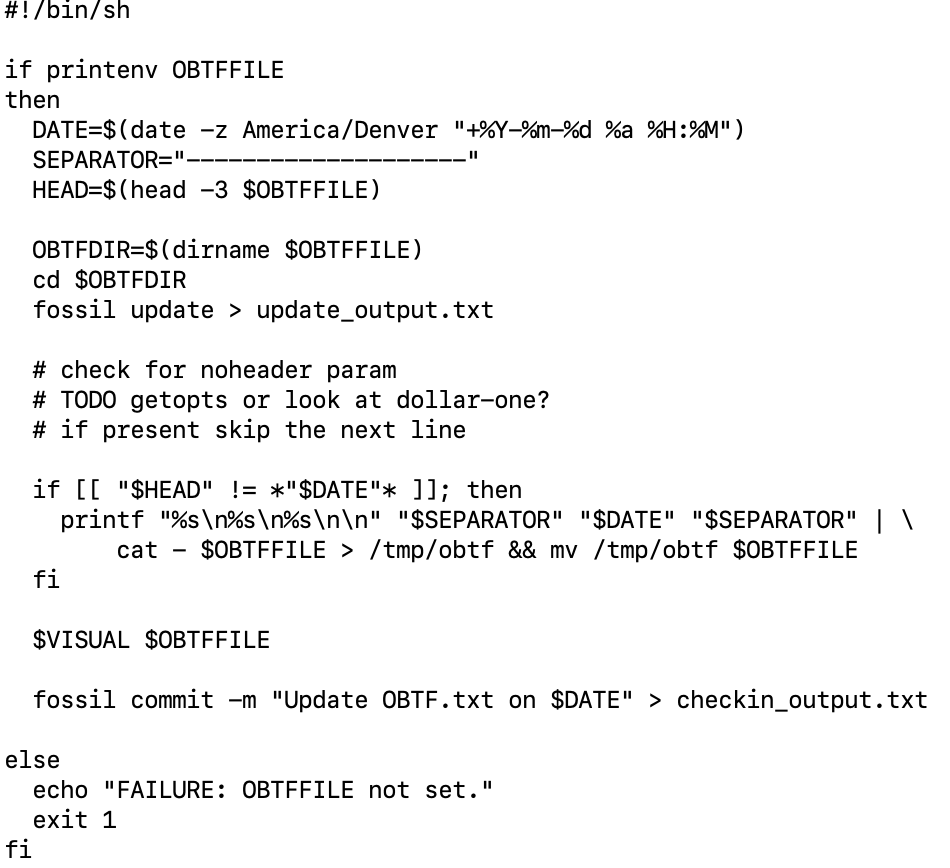
I'm also still using todo.sh, and have started poking at that so that when I finish a task, it will get archived, and also copied into the obtf.txt file, but that integration is a little tricky, as I'd like this to work from any of the machines I use on a regular basis. I'm also going to have to set up a fossil for my fork of todo.sh.
But the obtf.txt file is serving as a prod to get me to get all my various machines talking to my VPS so that there is a single source of TRVTH out there somewhere and I don't have to think about merging documents and such. So I've been writing scripts and such to do the things I mostly use the file for.
Specifically, here are the things I do with it:
- A daily journal. Most of the things I do that seem worth remembering get put in there.
- A place to stash ideas that I can search for later. I do this by putting IDEA somewhere in the line.
- A place to archive things I've completed from my todo list. (grep for DONE to find them).
- A place to leave random notes for myself.
Most of these are pretty simple, but as I'm using long lines in the file, I wanted to print things with a blank line between them. For example, to dump all the IDEAs out, I use the following ideas script:
#!/usr/bin/awk -f
/IDEA/ {print $0, "\n"}
There's more coming, but mostly I'm working on getting scripts written to deploy fossils on each new machine I set up, and make them link back to the master fossil on my VPS.
We Go Where We're Looking
from Dallineation
Today was Stake Conference in my LDS stake. That meant we didn't have 8:30am ward meetings and a 1pm conference meeting instead. So it presented an opportunity for me to attend my first Sunday Mass at my local Catholic parish at 10am.
I've attended Sunday Mass several times with my mother and step-dad at their parish, and I've gone to a few Saturday evening ones at mine, but I wanted to see what a Sunday Mass was like here.
It was well-attended, with lovely music, and beautifully-presented liturgy. The homily today was based mostly on the Gospel reading today, which was the “Parable of the Ten Virgins” from Matthew 25:1-13.
Jesus told his disciples this parable: “The kingdom of heaven will be like ten virgins who took their lamps and went out to meet the bridegroom. Five of them were foolish and five were wise. The foolish ones, when taking their lamps, brought no oil with them, but the wise brought flasks of oil with their lamps. Since the bridegroom was long delayed, they all became drowsy and fell asleep. At midnight, there was a cry, 'Behold, the bridegroom! Come out to meet him!' Then all those virgins got up and trimmed their lamps. The foolish ones said to the wise, 'Give us some of your oil, for our lamps are going out.' But the wise ones replied, 'No, for there may not be enough for us and you. Go instead to the merchants and buy some for yourselves.' While they went off to buy it, the bridegroom came and those who were ready went into the wedding feast with him. Then the door was locked. Afterwards the other virgins came and said, 'Lord, Lord, open the door for us!' But he said in reply, 'Amen, I say to you, I do not know you.' Therefore, stay awake, for you know neither the day nor the hour.”
Father Shumway focused most of his remarks on being prepared for death and the role of Catholic Priests in performing the Sacrament of Anointing of the Sick for people who are gravely ill. It was a good homily and I learned a lot about the importance of this sacrament to Catholics.
I went to my LDS Stake Conference this afternoon thinking about that parable and its many meanings and symbolisms. Many of the talks given at this meeting were centered around the theme of keeping our focus on Jesus Christ.
As one speaker remarked, “we tend to go where we're looking,” and that seemed to encapsulate the theme nicely.
Are we looking – or trying to look – to Jesus Christ? Or is our gaze drawn elsewhere? (The answer to both questions for me is yes, but I'm trying to do better.)
It also got me thinking about the state of my own faith journey. I'm in this weird stage where I'm pretty seriously investigating Catholicism but still an actively practicing Latter-day Saint.
I am trying to take my time with my exploration of Catholicism because I know my personality. I tend to become fixated on things to the point of obsession, and I need to know for sure that this isn't just some other fixation.
Am I drawn towards Catholicism because that's where I've been looking much of the time for the past year? Because it's novel and new and exciting? When the novelty wears off, will I feel the same? Or is there something more, something real that is drawing me there?
One other thing from Stake Conference today. One of the speakers openly said he struggles with doubts about some things regarding Joseph Smith, church history, and church policy, but that as he keeps his focus on Jesus Christ, he feels peace and reassurance. It was refreshing for me to hear that, as I can absolutely relate.
So I will keep trying to look to Jesus Christ in the midst of this weird faith journey of mine. And I trust that I'll eventually go where I'm looking.
#100DaysToOffload (No. 197) #faith #Christianity
ทางเข้า PG Slot ใหม่ล่าสุด 2026 สล็อตเว็บตรง ไม่ผ่านเอเย่นต์ ฝากถอนวอเลท ไม่มีขั้นต่ำ ระบบออโต้
from ทางเข้า PG Slot ใหม่ล่าสุด 2026 สล็อตเว็บตรง ระบบวอเลทและออโต้


ถ้าพูดถึง PG Slot ในปี 2026 ผมเชื่อว่าหลายคนน่าจะคุ้นเคยกับชื่อนี้กันอยู่แล้วครับ โดยเฉพาะคนที่สนใจเกมสล็อตออนไลน์ เพราะเกมจากค่าย PG Soft มีให้เลือกหลายรูปแบบ ทั้งเกมแนวผจญภัย แฟนตาซี ผลไม้ และเกมที่ได้รับแรงบันดาลใจจากวัฒนธรรมเอเชีย จุดเด่นที่เห็นได้ชัดคือการออกแบบเกมให้รองรับมือถือ และมีระบบการเล่นที่ค่อนข้างเข้าใจง่าย
แต่สิ่งที่ผมอยากพูดถึงในบทความนี้ไม่ได้มีแค่ตัวเกมสล็อตครับ เพราะเวลาค้นหาคำว่า ทางเข้า PG Slot ใหม่ล่าสุด เรามักจะเจอเว็บไซต์จำนวนมากที่ใช้คำโฆษณาคล้ายกัน เช่น สล็อตเว็บตรง ไม่ผ่านเอเย่นต์ ฝากถอนวอเลท ไม่มีขั้นต่ำ หรือระบบออโต้ตลอด 24 ชั่วโมง
คำถามสำคัญคือ เราจะรู้ได้อย่างไรว่าข้อมูลเหล่านั้นเชื่อถือได้จริง?
ผมจึงอยากรวบรวมประเด็นที่ควรศึกษาเกี่ยวกับ PG Slot ตั้งแต่การตรวจสอบเว็บไซต์ ระบบสมาชิก การฝากถอนผ่านวอเลท ไปจนถึงการทำความเข้าใจค่า RTP และความเสี่ยงของเกมสล็อต เพื่อให้ผู้อ่านมีข้อมูลประกอบการตัดสินใจมากขึ้นครับ
ทางเข้า PG Slot ใหม่ล่าสุด 2026 คืออะไร?
คำว่า ทางเข้า PG Slot โดยทั่วไปหมายถึงลิงก์หรือหน้าเว็บไซต์ที่เปิดให้ผู้ใช้งานเข้าถึงเกมสล็อตของค่าย PG Soft ผ่านระบบของผู้ให้บริการแต่ละราย ซึ่งอาจมีทั้งหน้าเว็บไซต์สำหรับมือถือและคอมพิวเตอร์
อย่างไรก็ตาม สิ่งหนึ่งที่ควรเข้าใจคือ PG Soft เป็นผู้พัฒนาเกม ไม่ได้หมายความว่าทุกเว็บไซต์ที่นำชื่อ PG Slot ไปใช้จะเป็นเว็บไซต์อย่างเป็นทางการหรือได้รับอนุญาตจากผู้พัฒนาโดยตรง
สำหรับผม การตรวจสอบทางเข้าเว็บไซต์จึงสำคัญกว่าการเลือกจากข้อความโฆษณาเพียงอย่างเดียว โดยเฉพาะเว็บไซต์ที่เปลี่ยนโดเมนบ่อย มีลิงก์สำรองจำนวนมาก หรือไม่แสดงข้อมูลผู้ดำเนินการอย่างชัดเจน
ก่อนใช้งานควรตรวจสอบชื่อโดเมน การเชื่อมต่อ HTTPS ข้อมูลติดต่อ เงื่อนไขการให้บริการ และความสอดคล้องของข้อมูลที่แสดงบนเว็บไซต์ รวมถึงหลีกเลี่ยงการเปิดลิงก์จากข้อความที่ไม่ทราบแหล่งที่มา
สล็อตเว็บตรง ไม่ผ่านเอเย่นต์ แตกต่างจากเว็บไซต์ทั่วไปอย่างไร?
อีกหนึ่งคำค้นหาที่พบได้บ่อยคือ สล็อตเว็บตรง ไม่ผ่านเอเย่นต์ ซึ่งเว็บไซต์หลายแห่งนำมาใช้เพื่อสื่อว่ามีระบบให้บริการโดยไม่ต้องผ่านตัวแทนหลายทอด
แต่ในความเป็นจริง คำว่าเว็บตรงไม่ได้มีนิยามมาตรฐานที่สามารถใช้ยืนยันความน่าเชื่อถือของเว็บไซต์ได้ทันทีครับ
บางเว็บไซต์อาจใช้คำนี้เพื่ออธิบายรูปแบบการให้บริการ ขณะที่บางแห่งใช้เป็นเพียงข้อความทางการตลาด ดังนั้นผมจึงไม่แนะนำให้ตัดสินจากคำว่าเว็บตรง 100% เพียงอย่างเดียว
สิ่งที่ควรพิจารณาคือเว็บไซต์มีการเปิดเผยข้อมูลผู้ประกอบการหรือไม่ มีเงื่อนไขการใช้งานที่อ่านเข้าใจง่ายหรือเปล่า และสามารถตรวจสอบใบอนุญาตจากหน่วยงานที่เกี่ยวข้องได้จริงหรือไม่
นอกจากนี้ ยังควรตรวจสอบข้อกฎหมายในประเทศที่ผู้ใช้งานอาศัยอยู่ เพราะการเข้าถึงเว็บไซต์ได้ไม่ได้หมายความว่าการให้บริการหรือการเข้าร่วมเล่นจะถูกกฎหมายเสมอไป
PG Slot ฝากถอนวอเลท ไม่มีขั้นต่ำ มีข้อควรรู้อะไรบ้าง?
ระบบวอเลทเป็นอีกหนึ่งหัวข้อที่ได้รับความสนใจ เนื่องจากหลายคนคุ้นเคยกับการใช้กระเป๋าเงินอิเล็กทรอนิกส์ในการชำระเงินออนไลน์
เมื่อค้นหาคำว่า PG Slot ฝากถอนวอเลท ไม่มีขั้นต่ำ เราอาจพบเว็บไซต์ที่โฆษณาว่าสามารถทำรายการด้วยจำนวนเงินน้อยและมีระบบประมวลผลอัตโนมัติ
อย่างไรก็ตาม คำว่าไม่มีขั้นต่ำควรได้รับการตรวจสอบจากเงื่อนไขจริงของผู้ให้บริการ เพราะแต่ละเว็บไซต์อาจกำหนดยอดฝากขั้นต่ำ ยอดถอนขั้นต่ำ ค่าธรรมเนียม หรือข้อจำกัดการทำธุรกรรมแตกต่างกัน
สำหรับผม ประเด็นที่ต้องให้ความสำคัญคือความปลอดภัยของข้อมูลทางการเงิน โดยเฉพาะการขอรหัสผ่าน รหัส OTP หรือข้อมูลส่วนบุคคลที่ไม่จำเป็นต่อการทำธุรกรรม
เว็บไซต์ที่อ้างว่ารองรับวอเลทไม่ได้หมายความว่ามีความร่วมมืออย่างเป็นทางการกับผู้ให้บริการกระเป๋าเงินอิเล็กทรอนิกส์นั้นเสมอไป และผู้ใช้งานควรตรวจสอบข้อกำหนดของผู้ให้บริการชำระเงินด้วยครับ
ระบบออโต้ PG Slot ทำงานอย่างไร?
คำว่า ระบบออโต้ ในเว็บไซต์เกมสล็อตมักใช้เรียกระบบที่ช่วยประมวลผลรายการบางประเภทโดยอัตโนมัติ เช่น การตรวจสอบธุรกรรม การอัปเดตยอดคงเหลือ หรือการแสดงสถานะรายการ
ในทางเทคนิค ระบบเหล่านี้อาจเชื่อมต่อกับบริการภายนอกผ่าน API หรือใช้กระบวนการตรวจสอบข้อมูลตามเงื่อนไขที่ผู้ให้บริการกำหนด
แต่ผมอยากเน้นว่า ระบบออโต้ไม่ได้รับประกันว่าทุกรายการจะเสร็จสมบูรณ์ทันที เพราะยังมีปัจจัยอื่นเข้ามาเกี่ยวข้อง เช่น ความพร้อมของระบบธนาคาร การตรวจสอบบัญชี และข้อจำกัดของผู้ให้บริการชำระเงิน
หากเว็บไซต์โฆษณาว่าฝากถอนสำเร็จภายในไม่กี่วินาทีทุกครั้ง ก็ควรมองว่าเป็นคำกล่าวอ้างที่ต้องมีหลักฐานรองรับ ไม่ใช่ข้อเท็จจริงที่ใช้ได้กับทุกสถานการณ์
จุดเด่นของเกมสล็อต PG Soft ในปี 2026
เมื่อพูดถึงตัวเกม ผมมองว่า PG Soft มีเอกลักษณ์ด้านการออกแบบที่ค่อนข้างชัดเจน โดยเฉพาะการนำเสนอภาพเคลื่อนไหว เสียงประกอบ และธีมที่หลากหลาย
เกมสล็อตบางเกมใช้วงล้อแบบดั้งเดิม ขณะที่บางเกมมีระบบสัญลักษณ์พิเศษ ตัวคูณ หรือฟีเจอร์โบนัสที่เพิ่มความซับซ้อนให้กับรูปแบบการเล่น
อีกจุดหนึ่งที่น่าสนใจคือการออกแบบสำหรับมือถือ ซึ่งช่วยให้ผู้เล่นสามารถดูรายละเอียดของเกมได้บนหน้าจอขนาดเล็กโดยไม่จำเป็นต้องใช้คอมพิวเตอร์
อย่างไรก็ตาม ประสิทธิภาพการแสดงผลยังขึ้นอยู่กับอุปกรณ์ ความเร็วอินเทอร์เน็ต และเว็บไซต์ที่นำเกมไปให้บริการด้วย
ก่อนศึกษาเกมใดเกมหนึ่ง ผมแนะนำให้อ่านกติกา ตารางการจ่ายรางวัล และรายละเอียดฟีเจอร์ภายในเกมให้ครบถ้วน เพราะเกมสล็อตแต่ละเกมมีเงื่อนไขแตกต่างกันครับ
ค่า RTP ของ PG Slot สำคัญอย่างไร?
RTP ย่อมาจาก Return to Player เป็นค่าทางสถิติที่ใช้แสดงสัดส่วนผลตอบแทนตามแบบจำลองของเกมในระยะยาว
ตัวอย่างเช่น หากเกมสล็อตมี RTP ตามทฤษฎี 96% หมายความว่าแบบจำลองทางคณิตศาสตร์ของเกมกำหนดผลตอบแทนเฉลี่ยระยะยาวไว้ที่ 96% ของยอดเดิมพันรวม ไม่ได้หมายความว่าผู้เล่นแต่ละคนจะได้รับเงินคืน 96 บาทจากการเดิมพัน 100 บาท
ผลลัพธ์ของการเล่นแต่ละครั้งยังมีความไม่แน่นอน และอาจแตกต่างจากค่าเฉลี่ยอย่างมาก
นอกจาก RTP แล้ว ยังมีคำว่า Volatility หรือความผันผวน ซึ่งใช้บอกลักษณะการกระจายของผลตอบแทนภายในเกม
สำหรับผม การทำความเข้าใจสองค่านี้มีประโยชน์มากกว่าการเชื่อข้อความประเภทเกมสล็อตแตกง่าย เพราะไม่มีค่า RTP หรือสูตรใดที่สามารถรับประกันผลชนะในการเล่นแต่ละครั้งได้
ทดลองเล่นสล็อต PG Slot ก่อนศึกษาระบบเงินจริง
เกมสล็อตบางรายการมีโหมดทดลองเล่นหรือ Demo ซึ่งช่วยให้ผู้สนใจเรียนรู้กติกาและฟีเจอร์ต่าง ๆ โดยไม่จำเป็นต้องใช้เงินจริง
ผมมองว่าโหมดทดลองมีประโยชน์ในแง่การศึกษา เพราะทำให้เข้าใจว่าสัญลักษณ์แต่ละประเภททำงานอย่างไร ฟีเจอร์โบนัสเกิดขึ้นภายใต้เงื่อนไขใด และรูปแบบของเกมแตกต่างกันอย่างไร
แต่สิ่งที่ต้องแยกให้ออกคือ ผลลัพธ์ที่เกิดขึ้นในโหมดทดลองไม่สามารถนำไปใช้ทำนายผลลัพธ์ของการเล่นด้วยเงินจริงได้
การชนะติดต่อกันในช่วงทดลองจึงไม่ใช่หลักฐานว่าเกมกำลังอยู่ในช่วงจ่ายรางวัลสูง หรือจะให้ผลลัพธ์แบบเดียวกันเมื่อเปลี่ยนไปใช้เงินจริง
วิธีตรวจสอบเว็บไซต์ PG Slot ให้รอบคอบ
เมื่อพบเว็บไซต์ที่ใช้คำว่า ทางเข้า PG Slot ใหม่ล่าสุด หรือสล็อตเว็บตรง 100% ผมจะเริ่มจากการดูข้อมูลพื้นฐานของเว็บไซต์ก่อนเสมอครับ
เว็บไซต์ควรมีข้อมูลเกี่ยวกับผู้ให้บริการ เงื่อนไขสมาชิก นโยบายความเป็นส่วนตัว และช่องทางติดต่อที่ตรวจสอบได้ ไม่ใช่มีเพียงปุ่มสมัครสมาชิกกับข้อความโฆษณา
นอกจากนี้ ควรระวังเว็บไซต์ที่ใช้ชื่อหรือโลโก้ของแบรนด์อื่นโดยไม่มีคำอธิบายความเกี่ยวข้อง รวมถึงเว็บไซต์ที่ขอให้ติดตั้งแอปพลิเคชันจากไฟล์ที่ไม่ทราบแหล่งที่มา
อีกประเด็นหนึ่งคือการกล่าวอ้างเรื่องใบอนุญาต หากเว็บไซต์แสดงหมายเลขใบอนุญาต ก็ควรตรวจสอบกับฐานข้อมูลของหน่วยงานผู้ออกใบอนุญาตโดยตรง
การมีใบอนุญาตจากต่างประเทศไม่ได้หมายความว่าจะได้รับอนุญาตให้ดำเนินการในประเทศไทย และไม่ใช่หลักประกันว่าจะไม่มีความเสี่ยงทางการเงินครับ
เล่นเกมสล็อตอย่างรับผิดชอบ สำคัญกว่าการตามหาเว็บแตกง่าย
ผมคิดว่าหัวข้อนี้เป็นสิ่งที่ไม่ควรมองข้าม โดยเฉพาะเมื่อเกมสล็อตถูกออกแบบให้มีภาพเคลื่อนไหวและระบบการเล่นที่รวดเร็ว
การเล่นต่อเนื่องเป็นเวลานานอาจทำให้ประเมินจำนวนเงินและเวลาที่ใช้ไปได้ยากขึ้น ดังนั้นจึงควรกำหนดขอบเขตของตนเองอย่างชัดเจน และไม่ใช้เงินที่จำเป็นต่อค่าใช้จ่ายในชีวิตประจำวัน
ที่สำคัญ ไม่ควรมองเกมสล็อตเป็นช่องทางสร้างรายได้หรือวิธีแก้ปัญหาทางการเงิน เพราะเกมมีความได้เปรียบทางคณิตศาสตร์ของผู้ให้บริการในระยะยาว
หากเริ่มรู้สึกว่าควบคุมเวลาและค่าใช้จ่ายไม่ได้ ควรหยุดเล่นและขอความช่วยเหลือจากผู้เชี่ยวชาญหรือหน่วยงานที่เกี่ยวข้อง
สรุป ทางเข้า PG Slot ใหม่ล่าสุด 2026 ควรพิจารณาอะไร?
จากที่ผมอธิบายมาทั้งหมด จะเห็นว่าคำว่า ทางเข้า PG Slot ใหม่ล่าสุด สล็อตเว็บตรง ไม่ผ่านเอเย่นต์ ฝากถอนวอเลท ไม่มีขั้นต่ำ ระบบออโต้ 2026 ครอบคลุมประเด็นหลายด้าน ไม่ใช่แค่เรื่องการเข้าถึงเกมสล็อตเท่านั้น
สิ่งที่ควรให้ความสำคัญคือความน่าเชื่อถือของเว็บไซต์ ความโปร่งใสของผู้ให้บริการ ความปลอดภัยของข้อมูล และความเข้าใจเกี่ยวกับความเสี่ยงของเกม
ส่วนคำโฆษณาอย่างเว็บตรง 100% ฝากถอนเร็ว หรือไม่มีขั้นต่ำ ควรตรวจสอบกับเงื่อนไขที่เผยแพร่จริงก่อนเชื่อถือ
สำหรับผม การมีข้อมูลที่ถูกต้องและตรวจสอบได้ย่อมมีประโยชน์มากกว่าการตัดสินใจจากคำโฆษณาที่ดูน่าสนใจเพียงอย่างเดียวครับ
คำถามที่พบบ่อยเกี่ยวกับ PG Slot 2026
1. ทางเข้า PG Slot ใหม่ล่าสุดคืออะไร?
หมายถึงหน้าเว็บไซต์หรือลิงก์สำหรับเข้าถึงเกมสล็อต PG Soft ผ่านผู้ให้บริการต่าง ๆ โดยควรตรวจสอบแหล่งที่มาและความน่าเชื่อถือของเว็บไซต์ก่อนใช้งาน
2. สล็อตเว็บตรง ไม่ผ่านเอเย่นต์ ตรวจสอบอย่างไร?
ควรตรวจสอบข้อมูลผู้ดำเนินการ ใบอนุญาต เงื่อนไขการให้บริการ และความสัมพันธ์กับผู้พัฒนาเกม เพราะคำว่าเว็บตรงเพียงอย่างเดียวไม่สามารถยืนยันสถานะของเว็บไซต์ได้
3. PG Slot ฝากถอนวอเลท ไม่มีขั้นต่ำจริงหรือไม่?
ขึ้นอยู่กับเงื่อนไขของแต่ละเว็บไซต์ ไม่สามารถยืนยันได้ว่าทุกผู้ให้บริการรองรับวอเลทหรือไม่มีขั้นต่ำเหมือนกันทั้งหมด
4. ระบบออโต้ PG Slot ทำรายการได้ตลอด 24 ชั่วโมงหรือไม่?
บางระบบอาจรองรับการประมวลผลอัตโนมัติ แต่ความสำเร็จและระยะเวลาของธุรกรรมขึ้นอยู่กับระบบชำระเงิน การตรวจสอบบัญชี และข้อกำหนดของผู้ให้บริการ
5. ค่า RTP สูงหมายความว่าเกมสล็อตแตกง่ายหรือไม่?
ไม่ใช่ครับ RTP เป็นค่าเฉลี่ยทางทฤษฎีในระยะยาว ไม่สามารถใช้รับประกันผลชนะหรือคาดการณ์ผลของการเล่นครั้งถัดไปได้
6. PG Slot สามารถทดลองเล่นฟรีได้หรือไม่?
เกมสล็อตบางรายการมีโหมด Demo ให้ศึกษากติกาและฟีเจอร์โดยไม่ใช้เงินจริง แต่ความพร้อมของโหมดทดลองขึ้นอยู่กับเกมและช่องทางที่ให้บริการ
บทความนี้จัดทำขึ้นเพื่อให้ข้อมูลเกี่ยวกับเกมสล็อต PG Soft และการประเมินเว็บไซต์ที่เกี่ยวข้อง ไม่ใช่การรับรองผู้ให้บริการหรือการชักชวนให้เล่นพนันด้วยเงินจริง ผู้ใช้งานควรตรวจสอบกฎหมายในพื้นที่ของตนเองและตระหนักถึงความเสี่ยงทางการเงิน
Sunday
from  Roscoe's Story
In Summary: * Moving into the night meds and night prayers phase of my evening, I'm resolved to do things a bit differently tonight than for the last two nights. Rather than stay up as late (for me) as I can following basketball or football games, I'm going to make a determined effort to retire early and calmly. Tomorrow will find a Monday morning with its early chores that are never a part of the weekend mornings. So I'll want to have a good, restful sleep behind me to make the morning work better.
And I'm wishing a good, restful sleep for you all, too.
Prayers, etc.: * I have a daily prayer regimen I try to follow throughout the day from early morning, as soon as I roll out of bed, until head hits pillow at night.
Health Metrics: * bw= 220.90 lbs. * bp= 159/72 (62)
Exercise: * morning stretches, balance exercises, kegel pelvic floor exercises, half squats, calf raises, toe raises, wall push-ups, BP breathing exercises, pilates
Diet: * 06:15 – 1 banana, 4 little cookies * 08:20 – 1 ham & cheese sandwich * 12:00 – snacking on chocolate covered raisins * 13:45 – mashed potatoes & gravy, 4 hamburger rolls * 16:00 – 1 fresh apple
Activities, Chores, etc.: * 05:00 – wake * 06:00 – bank accounts activity monitored * 06:30 – read, write, pray, follow news reports from various sources, surf the socials, take daily meds, unpack, organize, and nap * 12:00 – watching FOXNFL broadcast of the Colts / Cowboys game – and the Cowboys win this one, 27 to 23 * 16:30 – listening to relaxing music * 17:00 – follow news reports from various sources
Chess: * 10:50 – moved in all pending CC games
A Failure of Words
 Ceci n’est pas un blog.
I love writing, I think I’m ok at it, and I do it a lot. One area where I consistently seem to fail at writing is finding the words for sympathy cards. I love handwritten notes and often save them, but writing them myself is extra difficult. I often sit at my desk, with a pen hovering above a blank card and completely freeze. As deeply as I think about loss and ponder how people live their lives after loss, I fall embarrassingly short when trying to express my support after someone else’s loss. Truthfully, it almost brings up a feeling of shame because I feel I should have more skill and ease in this area.
Suffice it to say though, “I’m sorry for your loss” is hot garbage.
When I told people my dad was sick, I frequently got the response of “I’m so sorry!” These people meant well, of course, and this phrase is considered the socially acceptable thing to say. The challenge for me in these interactions was my response. I often became so uncomfortable, completely unsure of any response at all. I would freeze and give an awkward smile. Thanks, I guess? My mom started responding with, “Yeah, I’m sorry too.” And weren’t we all, facing the impending loss? Still, I have wished for more a more graceful way to answer.
This awkwardness of mine extends to writing sympathy cards. I don’t want to simply say, “Sorry for your loss” because there seems to be an ocean of feelings I’d like to express. “Omg, that sucks” only works for certain recipients (although it works quite well, when appropriate). How does one express the depth of feeling, and in a way that is actually helpful?
For some reason, my smallish team at work has experienced a surprising number of losses of family members this summer. Some of them have been old and sick, like my dad. Some just sick, from chronic illness. And some neither old nor sick, making the level of shock a noteworthy factor at play. For example, one of my coworkers recently joined what I tastelessly refer to as The Dead Siblings Club. She lost her sibling in a tragic and mostly unexpected way which had remarkable and awful parallels to the loss of my little brother. I’ve been a member of this club for 16 years already, and still, thinking of the early weeks and months after that loss, they were some of the most painful experiences I’ve ever had and probably ever will. And I somehow wanted to convey to my coworker that while I don’t precisely know how she feels, I have been walking a similar path for quite a long time.
Saying to this coworker, “I’m so sorry for your loss” felt hollow and cheap. I wanted to convey so much more to her, about how I know that the feeling of anguish seems like it will never leave, but eventually things do start to look different. Eventually you can sort of learn to breathe again. I have no magic advice for this. It took years for me to be able to talk about my brother without dissolving into sobs or becoming even a bit teary. Immediately after he died, I spent about two weeks straight lying on the sofa in my parents’ den, mostly staring at the ceiling. A lot of people reached out to me at the time, and of course I appreciated their love and support, but I had no words and no energy to respond. And no matter how amazing their written support, whether cards or emails, nothing seemed to penetrate the thick fog of grief that I wading through at the time.
I often avoid asking people who recently went through a loss, “How are you?” Because honestly, what kind of question is that? I’ve always hated answering that question in this context, and so I try to skip asking it. In the case of my coworker, I did ask her how she’s been doing since her loss, but I prefaced it with the disclaimer that the question was stupid and essentially meaningless. Fortunately, she laughed. It led to a conversation about how she has really been doing, given the chaos of her past few weeks.
Is there ever a truly correct answer to show support after someone else’s loss? Obviously it very much depends on who one is talking to, what their loss was, and one’s own relationship with that person to begin with. I strive for the non-generic. Probably I miss the mark more often than I’d care to. I’d like to include some helpful phrases here for others to use in these situations, but honestly, I’m not sure I have any. I think what I have found most helpful to read is an acknowledgment of how major of a change is in my own life. Nobody can do anything about that, but it feels helpful to have someone notice that this loss turns the world upside down.
And I think that’s the most important take away here: send the card. Say something, even if it is “Sorry for your loss.” Walking around carrying grief can feel like stepping onto an alien planet, and it’s nice to be noticed in this situation, rather than trying to blend in like nothing at all has happened. The best thing to say to someone who’s grieving? I see you.
✝️
from  💚
Our Father Who art in Heaven Hallowed be Thy name Thy Kingdom come Thy will be done on Earth as it is in Heaven Give us this day our daily Bread And forgive us our trespasses As we forgive those who trespass against us And lead us not into temptation But deliver us from evil
Amen
Jesus is Lord! Come Lord Jesus!
Come Lord Jesus! Christ is Lord!
Uncharted Waters
from onasixpence
All paths lead you there.
Why do you look for signposts?
The road always brings yer right back 'round.
To the metal gate and the wilderness beyond.
Keep your map though
It makes excellent kindling.
□